Class 10 Science MCQ Test Online – Chapter-Wise Practice
Introduction
Science in Class 10 is really three subjects rolled into one paper: physics, chemistry and biology, each with its own way of asking questions. A chemistry question wants a precise equation or property; a biology question wants a clear understanding of a process such as reproduction or coordination; a physics question often wants you to apply a formula correctly to a slightly changed situation. Reading through the textbook once rarely prepares a student equally well for all three.
This is exactly where a Class 10 Science MCQ test online can help. Instead of only reading definitions, diagrams and reactions, you get to apply what you have studied directly to a set of questions and see immediately where you stand. A short, focused test after finishing a chapter tells you far more about your actual preparation than another read-through of the same pages.
This page offers chapter-wise Science MCQ tests for Class 10 on the Aspirations Institute MCQ Tests portal, along with tests based on previous year questions for many chapters. You can pick a chapter you have studied, attempt a timed test, get your result instantly and go through explanations for the questions you got wrong. Over time, this simple habit of test, review and revise builds real confidence across physics, chemistry and biology before your board exams.
Many students feel comfortable with Science right after a class lecture but lose that confidence weeks later when the same concept comes back in a mixed question. Board exams frequently combine two ideas in one question, such as a chemical reaction question that also expects you to identify the type of reaction, or a biology question that links one process to another. A chapter-wise MCQ test online exposes you to this kind of question early, in a low-pressure setting, so the actual exam paper does not feel unfamiliar. Whether you are strong in biology but unsure about electricity, or comfortable with chemical reactions but shaky on the human eye, this page lets you focus your practice exactly where it is needed.
Quick Page Summary
- Class: 10
- Subject: Science
- Test Format: Chapter-wise MCQ tests, with previous year question (PYQ) based tests for several chapters
- Instant Results: Yes, with explanations
- Answer Explanations: Available
- Performance Analytics: Available
- Free Tests: Selected chapter tests are available at no cost
- Premium Tests: Additional tests available with sign-in and an active plan
What Can Students Practice?
On this page, you can practice Class 10 Science MCQ tests chapter by chapter, covering physics, chemistry and biology. The chapters currently covered include:
- Chemical Reactions and Equations
- Acids, Bases and Salts
- Metals and Non-Metals
- Carbon and its Compounds
- Life Processes
- Control and Coordination
- How Do Organisms Reproduce
- Heredity
- Light: Reflection and Refraction
- The Human Eye and the Colourful World
- Electricity
- Magnetic Effects of Electric Current
- Atoms and Molecules
- Environment
For most of these chapters, you will also find a dedicated previous year question (PYQ) test, which helps you understand how a topic has actually been asked in past board exam papers, in addition to the standard chapter-wise test. This range means you can choose a test that matches exactly where you are in your preparation, whether you have just finished studying a chapter or are doing a final revision before an exam.
Chemistry chapters such as Chemical Reactions and Equations, Acids, Bases and Salts, and Metals and Non-Metals are closely connected, since each builds on the idea of how substances react and change, so many students find it useful to attempt them in that order. Carbon and its Compounds is often treated as a separate, slightly tougher chapter and benefits from a dedicated chapter test once the naming and reactions of organic compounds are clear. In biology, Life Processes forms the base for Control and Coordination, and How Do Organisms Reproduce, so testing yourself on Life Processes first can make the later chapters easier to follow. Heredity is often studied alongside reproduction and is worth testing soon after, while the concepts are still connected in your mind. The physics chapters, Light, The Human Eye and the Colourful World, Electricity and Magnetic Effects of Electric Current, are calculation and diagram heavy, so it helps to attempt the chapter test only after you are comfortable with the relevant formulas and ray diagrams. Atoms and Molecules, and Environment are shorter, foundational chapters that are well suited to a quick chapter-wise test closer to your exam, as a way of confirming the basics are still fresh.
Why MCQ Practice Is Important
Science MCQ practice does something reading alone cannot do. It forces you to recall a fact, reaction, formula or process accurately and apply it to a specific situation, rather than just recognising it when you see it explained in the textbook.
When you attempt an MCQ, you have to read the question carefully, identify which chapter's concept is being tested, work out the correct answer and then match it to one of the given options, often while other options look almost correct. This is very close to what board exams expect in the objective-type section, where a well-designed question tests understanding rather than plain recall.
Regular MCQ practice also builds speed and accuracy together. Many students understand a concept well in class but still lose marks in the exam because they take too long thinking through a question they should be able to answer quickly, or because they rush and misread a value in a numerical question. Practicing chapter-wise tests under a time limit trains you to move at a steady pace across all three sections of Science without losing accuracy.
Perhaps most importantly, MCQ tests reveal your weak chapters clearly, chapter by chapter and even topic by topic within a chapter. It is common to feel confident about a subject like biology in general but discover, through a chapter-wise test, that reproduction terminology specifically needs more revision, or to feel comfortable with numericals in electricity but weak on circuit diagrams. Reviewing your mistakes after each test, rather than moving on immediately, is one of the most effective ways to convert a weak chapter into a stronger one before your final exams.
Because Class 10 Science combines conceptual questions, diagram-based questions and numerical questions, MCQ practice trains all three types of thinking at once. A well-designed chapter test does not just ask you to recall a definition; it also checks whether you can identify a reaction type, read a ray diagram, or apply a formula correctly, which mirrors the range of questions you are likely to see in your actual board exam.
There is also a cross-chapter benefit that is easy to miss. Several Class 10 Science chapters connect to each other in ways board papers like to test, such as a question that links electricity and magnetic effects, or one that connects control and coordination with reproduction. Practicing each chapter on its own first builds the individual foundation and once you feel steady across most chapters, revisiting a few tests together helps you notice these connections rather than being caught off guard when a question quietly draws on two chapters at once.
Main Features Of The Online Tests
The Class 10 Science tests on this page are built around a few features that make practice more useful:
- Chapter-Wise Tests: You can choose a test based on a specific chapter, covering physics, chemistry or biology, depending on what you want to revise.
- PYQ-Based Tests: For many chapters, a dedicated test built around previous year questions is also available, so you get a sense of how a topic has actually appeared in exams.
- Instant Results: As soon as you submit a test, you see your score right away, without waiting for anyone to check your paper.
- Answer Explanations: For the questions you get wrong, explanations are provided so that you understand the correct concept, not just the correct option.
- Performance Analytics: Your attempts are tracked over time, which helps you notice patterns, such as a chapter you consistently score lower in compared to others.
- Free and Premium Access: A number of chapter tests are available for free, so you can try the format and see how it works before deciding to explore premium tests for wider coverage.
How To Use The Tests Effectively
Simply attempting tests one after another without a plan will not help you as much as using them thoughtfully. Here is a simple approach that works well for most students:
- Finish studying a chapter properly first, including diagrams, reactions and solved numericals from your textbook, before attempting a test on it.
- Quickly revise the key definitions, equations or formulas from that chapter. For example, before an Electricity test, revise the formulas for resistance and power; before a Chemical Reactions test, revise how to balance and classify equations.
- Attempt the chapter-wise or PYQ test within a reasonable time limit, without checking your notes while attempting it, since the goal is to see what you can recall and apply on your own.
- Check your score as soon as you finish and notice which specific questions you got wrong rather than only the final number.
- Go through the explanations for every incorrect answer carefully. Understand why the correct option is right and just as importantly, why the option you chose was wrong.
- If you notice the same type of mistake repeating, such as confusing exothermic and endothermic reactions, or mixing up convex and concave lens behaviour, go back to that specific concept in your textbook before moving on.
- After a few days, reattempt a test on the same chapter, especially a PYQ-based one, to check whether your understanding has genuinely improved.
Following this cycle across physics, chemistry and biology, rather than testing yourself only occasionally, is what actually builds strong exam readiness in Science.
It also helps to keep a simple, personal record of your scores as you move through the syllabus, noting the chapter, the date and your score. Over a few months, this record shows you which chapters consistently need more attention, so your revision in the final weeks before the exam can be targeted rather than spread thinly across everything.
Simple Study Plan
| Stage | What to Do | Purpose |
| Before the test | Revise the chapter's definitions, equations and diagrams. | Refresh your memory before applying it under test conditions. |
| During the test | Attempt the chapter-wise or PYQ test within the given time. | Practice working at exam-like speed and focus. |
| Right after the test | Review every mistake and read the explanation for it. | Understand the correct concept, not just the correct answer. |
| Weekly revision | Reattempt tests, especially PYQ-based ones, for chapters covered so far. | Retain concepts and catch topics that need more work. |
| Before the board exam | Attempt chapter tests across physics, chemistry and biology once more. | Get a realistic sense of your overall preparation. |
A study plan like this works best when you follow it consistently through the term, rather than trying to complete all chapters in the final weeks before your exam.
Free And Premium Test Access
Selected chapter tests on this page are available for free, so you can try the format for chapters such as Chemical Reactions and Equations, Electricity and Life Processes without needing to sign in or subscribe to anything.
Beyond these, more chapter-wise and PYQ-based tests across the remaining chapters are available as premium content. Premium tests generally require you to sign in and have an active plan, which may cover Science alone or Science along with other Class 10 subjects, depending on what you choose. Since plans and their duration can change from time to time, it is best to check the current options directly on the page rather than relying on any fixed figure.
Whether you start with the free tests or move to premium access, the underlying format stays the same: chapter-based MCQs with instant results and explanations.
Who Should Attempt These Tests?
- Students who have just finished studying a Class 10 Science chapter and want to check their understanding immediately.
- Students preparing for CBSE board exams who want structured, chapter-wise revision across physics, chemistry and biology.
- Students who specifically want previous year question-style practice to understand exam patterns.
- Students who want to identify weak chapters early in the year, rather than discovering them close to the exams.
- Parents who want their child to follow a structured, trackable practice routine at home.
- Self-study students who do not have access to regular tuition and want a reliable way to test their own progress.
Common Mistakes Students Should Avoid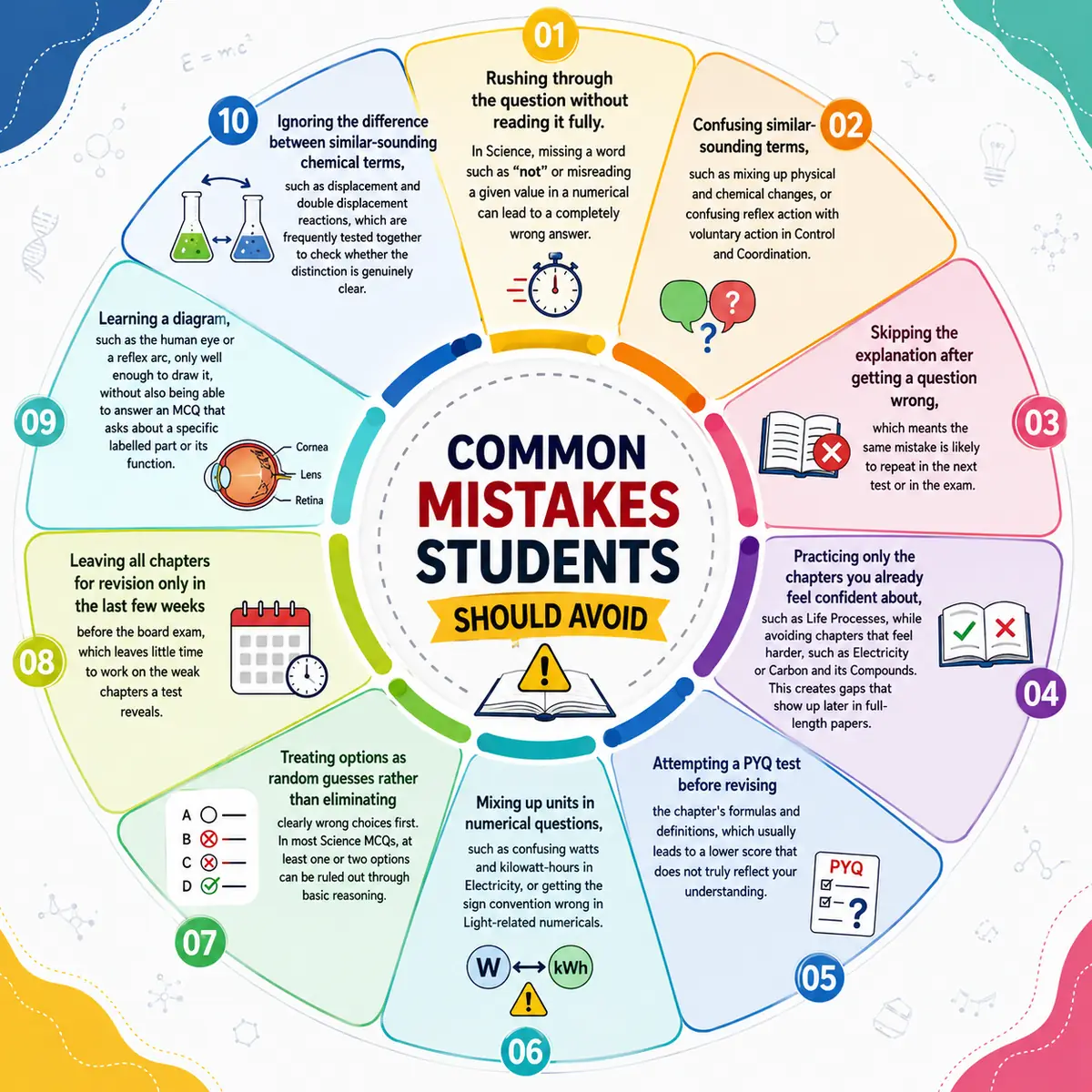
- Rushing through the question without reading it fully. In Science, missing a word such as "not" or misreading a given value in a numerical can lead to a completely wrong answer.
- Confusing similar-sounding terms, such as mixing up physical and chemical changes, or confusing reflex action with voluntary action in Control and Coordination.
- Skipping the explanation after getting a question wrong, which means the same mistake is likely to repeat in the next test or in the exam.
- Practicing only the chapters you already feel confident about, such as Life Processes, while avoiding chapters that feel harder, such as Electricity or Carbon and its Compounds. This creates gaps that show up later in full-length papers.
- Attempting a PYQ test before revising the chapter's formulas and definitions, which usually leads to a lower score that does not truly reflect your understanding.
- Mixing up units in numerical questions, such as confusing watts and kilowatt-hours in Electricity, or getting the sign convention wrong in Light-related numericals.
- Treating options as random guesses rather than eliminating clearly wrong choices first. In most Science MCQs, at least one or two options can be ruled out through basic reasoning.
- Leaving all chapters for revision only in the last few weeks before the board exam, which leaves little time to work on the weak chapters a test reveals.
- Learning a diagram, such as the human eye or a reflex arc, only well enough to draw it, without also being able to answer an MCQ that asks about a specific labelled part or its function.
- Ignoring the difference between similar-sounding chemical terms, such as displacement and double displacement reactions, which are frequently tested together to check whether the distinction is genuinely clear.
Why Use Aspirations Institute MCQ Tests?
Aspirations Institute has been working in school education and exam preparation for more than 22 years and the MCQ Tests portal is built around that classroom experience. Rather than offering generic question banks, the Class 10 Science tests are organised chapter by chapter across physics, chemistry and biology, in line with how the subject is actually taught and examined.
The combination of chapter-wise and PYQ-based tests, instant results, written explanations and performance analytics is designed to support a genuine study routine, not just a one-time quiz. Whether you are using the free tests to get started or exploring premium access for more complete coverage, the goal remains the same: to help you practice Science in a structured, exam-focused way and become clear about where you stand before your board exams.
Because the tests are organised by the same team that has been involved in school education since 2004, the questions are written with an understanding of how CBSE Class 10 Science is actually taught in the classroom, rather than being generic questions collected from unrelated sources.
Final Call To Action
Pick a chapter you have recently studied and see how well you have understood it.
Frequently Asked Questions
1. Are free Class 10 Science MCQ tests available on this page?
Yes, selected chapter tests, such as Chemical Reactions and Equations, Electricity and Life Processes, are available for free without needing to sign in. This lets students across physics, chemistry and biology try the chapter-wise format and check their preparation before deciding whether premium tests for the remaining chapters would help.
2. Do the tests include answer explanations?
Yes, explanations are provided for the questions you get wrong, so you understand the correct concept rather than only the final answer. This matters in Science, where a question can combine two ideas, such as a reaction type and its equation and the explanation shows exactly which part you missed.
3. Are the tests organised chapter-wise?
Yes, the tests are organised chapter-wise across physics, chemistry and biology, covering all fourteen chapters from Chemical Reactions and Equations to Environment. Many chapters also have a dedicated previous year question based test, so you can check both your conceptual understanding and how the topic has actually appeared in board exam papers.
4. Do I need to sign in to attempt these tests?
Selected free tests, including chapters like Chemical Reactions and Equations, and Life Processes, can be attempted without signing in at all. Premium tests covering the remaining chapters and PYQ-based sets generally require you to sign in and hold an active plan, which may cover Science alone or alongside other Class 10 subjects.
5. Can I attempt these tests on my mobile phone?
Yes, the Class 10 Science MCQ tests can be attempted on a mobile phone, tablet or computer, since the portal is designed to work smoothly across devices. This makes it easy to fit in a quick chapter-wise practice session across physics, chemistry or biology between school, tuition and other daily commitments.
6. Is there negative marking in these tests?
Negative marking may apply to some of the chapter-wise or PYQ-based tests, though this can vary from one test to another. It is best to check the specific instructions shown before you begin a test, so you understand exactly how scoring works before attempting questions across physics, chemistry or biology.
7. How should I use my test results to improve?
Use your results to identify chapters or question types where you are making repeated mistakes, such as confusing exothermic and endothermic reactions or mixing up convex and concave lens behaviour and revise those specific concepts before reattempting a test to check whether your understanding has genuinely improved.
8. Are these tests useful for last-minute revision before the board exam?
Yes, chapter-wise and PYQ-based tests are particularly useful for a quick, structured revision closer to the board exam, since they let you check whether earlier weak chapters, such as Electricity or Carbon and its Compounds, have genuinely improved rather than relying only on a general re-read of the textbook.
9. What happens to premium test access after my plan ends?
Once a plan expires, access to the premium chapter-wise and PYQ-based tests included under that plan generally ends, since premium access is tied to an active subscription. However, the selected free chapter tests, such as Chemical Reactions and Equations, and Life Processes, remain available to attempt again at no cost.
10. Are the questions based on the CBSE Class 10 Science syllabus?
Yes, the tests are designed around the topics covered in the Class 10 Science syllabus, spanning physics, chemistry and biology chapters commonly asked about in CBSE board exams, so the practice stays closely aligned with what is actually taught and tested in the classroom.