Class 11 Chemistry MCQ Test Online – Chapter-Wise Practice
Introduction
Class 11 Chemistry is where the subject genuinely changes in character compared to earlier classes. Instead of straightforward facts and simple reactions, you now deal with atomic structure, periodicity, chemical bonding and thermodynamics, topics that ask you to reason through a concept rather than simply recall it. A student who reads a chapter and follows the logic in class can still struggle the moment a question rearranges the same idea into an unfamiliar form.
This is exactly where a Class 11 Chemistry MCQ test online can help. Instead of only reading through derivations, definitions and solved examples, you get to apply what you have studied directly to a set of questions and see immediately where your understanding holds up and where it does not. A short, focused test after finishing a chapter tells you far more about your actual preparation than reading the same pages again.
This page offers chapter-wise Chemistry MCQ tests for Class 11 on the Aspirations Institute MCQ Tests portal. You can pick a chapter you have studied, attempt a timed test, get your result instantly and go through explanations for the questions you got wrong. Over time, this simple habit of test, review and revise builds real confidence in a subject that forms the base for Class 12 Chemistry and for competitive exams such as JEE Main.
Many students feel comfortable with a chapter like Chemical Bonding right after a class lecture, since the logic makes sense while it is being explained, but then struggle weeks later when a question expects them to apply the same logic to a new molecule or situation. Exams at this level frequently test whether a concept has actually been understood, not just followed along with in class. A chapter-wise MCQ test online exposes this gap early, in a low-pressure setting, so the actual exam does not feel unfamiliar. Whether you are strong in atomic structure but unsure about equilibrium, or comfortable with basic concepts but shaky on redox reactions, this page lets you focus your practice exactly where it is needed.
Quick Page Summary
- Class: 11
- Subject: Chemistry
- Test Format: Chapter-wise MCQ tests
- Instant Results: Yes, with explanations
- Answer Explanations: Available
- Performance Analytics: Available
- Free Tests: A selected chapter test is available at no cost
- Premium Tests: Additional chapter tests available with sign-in and an active plan
What Can Students Practice?
On this page, you can practice Class 11 Chemistry MCQ tests chapter by chapter. The chapters currently covered include:
- Some Basic Concepts of Chemistry
- Structure of Atom
- Classification of Elements and Periodicity in Properties
- Chemical Bonding and Molecular Structure
- Thermodynamics
- Equilibrium
- Redox Reactions
- Some Basic Principles and Techniques (Organic Chemistry)
- Hydrocarbons
Some Basic Concepts of Chemistry is the natural starting point, since it introduces the mole concept and basic calculations used throughout the rest of the syllabus, including in physical chemistry chapters later in the year. Structure of Atom, and Classification of Elements and Periodicity in Properties are closely connected, since the periodic trends you study depend directly on atomic structure, so testing them close together helps the link between the two stay clear. Chemical Bonding and Molecular Structure builds on both of these and introduces its own set of theories and shapes, making it a chapter that benefits from a dedicated chapter test once the individual bonding theories are settled in your mind.
Thermodynamics and Equilibrium are often considered two of the more challenging chapters in Class 11 Chemistry, since both involve careful reasoning with formulas and conditions rather than simple recall and a chapter-wise test is a useful way to check whether the underlying logic, not just the formula, has been understood. Redox Reactions connects back to basic concepts and forward to later organic and inorganic chemistry, so it is worth testing on its own before moving to the organic chemistry chapters. Some Basic Principles and Techniques introduces the language and methods of organic chemistry and Hydrocarbons applies that language to a specific class of compounds, so many students find it useful to attempt these two chapters in that order.
Why MCQ Practice Is Important
Chemistry MCQ practice does something reading alone cannot do. It forces you to apply a formula, principle or reaction to a specific situation and select the correct answer, rather than just recognising the concept when you see it explained with a worked example.
When you attempt an MCQ, you have to read the question carefully, identify which principle from the chapter applies, work through the reasoning or calculation and then match your answer to one of the given options, often while other options represent common misunderstandings. This is very close to what board exams and, later, competitive exams expect from you in objective-type questions.
Regular MCQ practice also builds speed and accuracy together. Many students understand a concept like periodic trends or chemical bonding well in class but still lose marks in a timed test because they take too long working through a question they should be able to answer quickly, or because a small calculation error changes their final answer in a thermodynamics or equilibrium problem. Practicing chapter-wise tests under a time limit trains you to work at a steady, accurate pace.
Perhaps most importantly, MCQ tests reveal your weak chapters clearly. It is easy to feel confident about a topic like Structure of Atom after a class lecture, but a chapter-wise test will quickly show whether you can apply quantum numbers or electronic configuration rules to a question phrased differently from your textbook. Reviewing your mistakes after each test, rather than moving on immediately, is one of the most effective ways to convert a weak chapter into a strong one.
This matters even more in Chemistry than in some other subjects, because the chapters are not equally weighted in difficulty. A student can spend an equal amount of time on Some Basic Concepts of Chemistry and on Equilibrium and end up with very different levels of understanding, simply because one chapter has more conceptual layers than the other. Chapter-wise MCQ testing gives you a fair, comparable way to see this difference clearly, rather than assuming equal time spent means equal preparation.
Class 11 Chemistry is also the foundation year for Class 12 Chemistry and for competitive exams such as JEE Main, where physical chemistry chapters like Thermodynamics and Equilibrium reappear in more advanced forms. Building a genuinely solid base now, through regular chapter-wise MCQ practice rather than a single read-through, makes later study noticeably easier, since you are extending an understood concept rather than relearning it from scratch.
There is also a specific benefit to MCQ practice in the organic chemistry portion of the syllabus. Some Basic Principles and Techniques and Hydrocarbons introduce naming conventions, structures and reaction types that are easy to follow when explained step by step in class but harder to apply independently in a question that gives you a structure and asks for its correct name or gives you a reaction and asks for its correct product. Repeated MCQ practice on these two chapters is one of the more efficient ways to build this recognition skill, since each question offers a slightly different structure or reaction to work through.
Main Features Of The Online Tests
The Class 11 Chemistry tests on this page are built around a few features that make practice more useful:
- Chapter-Wise Tests: You can choose a test based on a specific chapter, covering both physical and organic chemistry topics from the Class 11 syllabus.
- Instant Results: As soon as you submit a test, you see your score right away, without waiting for anyone to check your paper.
- Answer Explanations: For the questions you get wrong, explanations are provided so that you understand the correct concept, not just the correct option.
- Performance Analytics: Your attempts are tracked over time, which helps you notice patterns, such as a chapter you consistently score lower in compared to others.
- Free and Premium Access: A chapter test is available for free, so you can try the format and see how it works before deciding to explore premium tests for the remaining chapters.
How To Use The Tests Effectively
Simply attempting tests one after another without a plan will not help you as much as using them thoughtfully. Here is a simple approach that works well for most students:
- Finish studying a chapter properly first, including derivations, definitions and solved examples from your textbook, before attempting a test on it.
- Quickly revise the key formulas and principles from that chapter. For example, before an Equilibrium test, revise the equilibrium constant expressions and Le Chatelier's principle; before a Chemical Bonding test, revise the different bonding theories and molecular shapes.
- Attempt the chapter-wise test within a reasonable time limit, without checking your notes while attempting it, since the goal is to see what you can apply on your own.
- Check your score as soon as you finish and notice which specific questions you got wrong rather than only the final number.
- Go through the explanations for every incorrect answer carefully. Understand why the correct option is right and why the option you chose, though it may have looked correct, was wrong.
- If you notice the same type of mistake repeating, such as confusing oxidation and reduction in Redox Reactions, or misapplying a periodic trend, go back to that specific concept in your textbook before moving on.
- After a few days, reattempt the same chapter test to check whether your understanding has genuinely improved, particularly for chapters like Thermodynamics and Equilibrium that many students find challenging on the first attempt.
Following this cycle across all nine chapters, rather than testing yourself only occasionally, is what actually builds strong exam readiness in Class 11 Chemistry.
It also helps to keep a simple, personal record of your scores as you move through the syllabus, noting the chapter, the date and your score. Over a few months, this record shows you which chapters consistently need more attention, so your revision in the final weeks before the exam can be targeted rather than spread thinly across everything.
Simple Study Plan
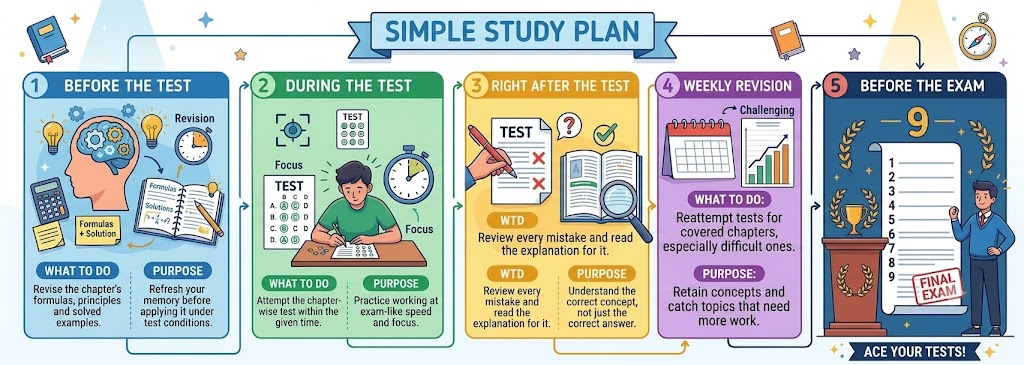
| Stage | What to Do | Purpose |
| Before the test | Revise the chapter's formulas, principles and solved examples. | Refresh your memory before applying it under test conditions. |
| During the test | Attempt the chapter-wise test within the given time. | Practice working at exam-like speed and focus. |
| Right after the test | Review every mistake and read the explanation for it. | Understand the correct concept, not just the correct answer. |
| Weekly revision | Reattempt tests for chapters covered so far, especially the more challenging ones. | Retain concepts and catch topics that need more work. |
| Before the exam | Attempt tests across all nine chapters once more. | Get a realistic sense of your overall preparation. |
A study plan like this works best when you follow it consistently through the term, rather than trying to complete all chapters in the final weeks before your exam.
Free And Premium Test Access
A chapter test for Some Basic Concepts of Chemistry is currently available for free, so you can try the format without needing to sign in or subscribe to anything.
Beyond this, chapter-wise tests for the remaining chapters, including Structure of Atom, Chemical Bonding and Molecular Structure, Thermodynamics, Equilibrium, Redox Reactions and the organic chemistry chapters, are available as premium content. Premium tests generally require you to sign in and have an active plan, which may cover Chemistry alone or Chemistry along with other Class 11 subjects, depending on what you choose. Since plans and their duration can change from time to time, it is best to check the current options directly on the page rather than relying on any fixed figure.
Whether you start with the free test or move to premium access, the underlying format stays the same: chapter-based MCQs with instant results and explanations.
Who Should Attempt These Tests?
- Students who have just finished studying a Class 11 Chemistry chapter and want to check their understanding immediately.
- Students preparing for CBSE school exams who want structured, chapter-wise revision rather than random practice.
- Students building a foundation for Class 12 Chemistry, since several chapters carry forward directly.
- Students preparing for competitive exams such as JEE Main, who want extra chapter-wise MCQ practice alongside their coaching material.
- Parents who want their child to follow a structured, trackable practice routine at home.
- Self-study students who do not have access to regular tuition and want a reliable way to test their own progress.
Common Mistakes Students Should Avoid
- Rushing through the question without reading it fully. In Chemistry, missing a condition such as temperature, pressure or a specific reagent can lead to a completely wrong answer.
- Confusing similar-sounding concepts, such as oxidation and reduction in Redox Reactions, or confusing different types of hybridisation in Chemical Bonding.
- Making small calculation errors under time pressure, especially in chapters like Some Basic Concepts of Chemistry, Thermodynamics and Equilibrium, where a single arithmetic slip changes the final answer.
- Skipping the explanation after getting a question wrong, which means the same mistake is likely to repeat in the next test or in the exam.
- Practicing only the chapters you already feel confident about, such as Structure of Atom, while avoiding chapters that feel harder, such as Equilibrium or Hydrocarbons. This creates gaps that show up later in full-length papers.
- Attempting a chapter test before revising the specific formulas and principles for that chapter, which usually leads to a lower score that does not truly reflect your understanding.
- Treating options as random guesses rather than eliminating clearly wrong choices first. In most Chemistry MCQs, at least one or two options can be ruled out through basic reasoning about the reaction or principle involved.
- Leaving all chapters for revision only in the last few weeks before the exam, which leaves little time to work on the weak chapters a test reveals.
- Learning a formula without understanding the conditions under which it applies, such as forgetting that certain equilibrium or thermodynamics expressions only hold under specific conditions.
- Skipping the naming and structure basics in organic chemistry chapters because they feel tedious, even though a large share of MCQs in this section depend directly on recognising a structure or name correctly.
Why Use Aspirations Institute MCQ Tests?
Aspirations Institute has been working in school education and exam preparation for more than 22 years and the MCQ Tests portal is built around that classroom experience. Rather than offering generic question banks, the Class 11 Chemistry tests are organised chapter by chapter, in line with how the subject is actually taught and examined.
The combination of chapter-wise tests, instant results, written explanations and performance analytics is designed to support a genuine study routine, not just a one-time quiz. Whether you are using the free test to get started or exploring premium access for more complete coverage, the goal remains the same: to help you practice Chemistry in a structured, exam-focused way and become clear about where you stand before your school exams and as you build towards Class 12.
Because the tests are organised by the same team that has been involved in school education since 2004, the questions are written with an understanding of how CBSE Class 11 Chemistry is actually taught in the classroom, rather than being generic questions collected from unrelated sources.
Final Call To Action
Pick a chapter you have recently studied and see how well you have understood it.
Frequently Asked Questions
1. Are free Class 11 Chemistry MCQ tests available on this page?
Yes, a chapter test for Some Basic Concepts of Chemistry is currently available for free without needing to sign in. Since this chapter introduces the mole concept and calculations used throughout the syllabus, it is a useful starting point before deciding whether premium tests for the remaining physical and organic chemistry chapters would help.
2. Do the tests include answer explanations?
Yes, explanations are provided for the questions you get wrong, so you understand the correct concept rather than only the final answer. This matters in Chemistry, where a small detail such as a missed condition or reagent can change the correct option and the explanation shows exactly which part of the reasoning you missed.
3. Are the tests organised chapter-wise?
Yes, the tests are organised chapter-wise across all nine Class 11 Chemistry chapters, covering physical chemistry topics such as Structure of Atom, Thermodynamics and Equilibrium, as well as organic chemistry chapters such as Basic Principles and Techniques and Hydrocarbons. This lets you focus your practice on one chapter at a time.
4. Do I need to sign in to attempt these tests?
The free chapter test for Some Basic Concepts of Chemistry can be attempted without signing in at all. Premium tests covering the remaining chapters, including Structure of Atom, Chemical Bonding, Thermodynamics and Equilibrium, generally require you to sign in and hold an active plan, which may cover Chemistry alone or with other Class 11 subjects.
5. Can I attempt these tests on my mobile phone?
Yes, the Class 11 Chemistry MCQ tests can be attempted on a mobile phone, tablet or computer, since the portal is designed to work smoothly across devices. This flexibility is useful for students juggling school, tuition and JEE Main foundation preparation, since a quick chapter-wise test can be fitted in almost anywhere.
6. Is there negative marking in these tests?
Negative marking may apply to some of the chapter-wise tests, though this can vary from one test to another. It is best to check the specific instructions shown before you begin a test, so you understand exactly how scoring works before attempting numerical or conceptual questions.
7. How should I use my test results to improve?
Use your results to identify chapters or question types where you are making repeated mistakes, such as confusing oxidation and reduction in Redox Reactions or misapplying a periodic trend and revise those specific concepts using your textbook before reattempting the same chapter test to check improvement.
8. Are these tests useful for last-minute revision before the exam?
Yes, chapter-wise tests are particularly useful for a quick, structured revision closer to the exam, since reattempting a test lets you check whether earlier weak chapters, such as Thermodynamics or Equilibrium, have genuinely improved rather than relying only on a general re-read of the textbook.
9. What happens to premium test access after my plan ends?
Once a plan expires, access to the premium chapter-wise tests included under that plan generally ends, since premium access is tied to an active subscription. However, the free chapter test for Some Basic Concepts of Chemistry remains available to attempt again at no cost even after your plan lapses.
10. Are the questions based on the CBSE Class 11 Chemistry syllabus?
Yes, the tests are designed around the topics covered in the Class 11 Chemistry syllabus, spanning physical, inorganic and organic chemistry chapters commonly asked about in CBSE exams, so the practice stays closely aligned with what is actually taught in the classroom and useful as a base for competitive exams like JEE Main.