Class 12 Accountancy MCQ Test Online – Chapter-Wise Practice
Introduction
Accountancy is a subject where accuracy matters as much as understanding. In Class 12, chapters on partnership accounting, company accounts and financial statement analysis introduce several new formats, ratios and adjustments and a small error early in a question can throw off everything that follows. Simply reading through the chapter and a few solved illustrations is often not enough to build the sort of accuracy board exams expect.
A Class 12 Accountancy MCQ test online gives you a fast, focused way to check whether you can actually apply what you have studied. Rather than only working through long-format numerical questions, you attempt objective questions on a specific chapter, see your result immediately and go through explanations for anything you got wrong.
This page offers chapter-wise Accountancy MCQ tests for Class 12 on the Aspirations Institute MCQ Tests portal, with more than one test available for each chapter. You can pick a chapter you have recently completed, attempt a test, check your score at once and revisit the concepts behind any mistakes. Practiced regularly through the year, this cycle of testing and reviewing builds sharper accuracy than working through long numericals alone.
Because Accountancy has a good number of chapters that build on each other, such as the different stages of partnership reconstitution, chapter-wise MCQ practice also helps you notice early if a concept from an earlier chapter has not been fully understood, before it starts affecting a later one.
Quick Page Summary
- Class: 12
- Subject: Accountancy
- Test Format: Chapter-wise MCQ tests, with more than one test available for most chapters
- Instant Results: Yes
- Answer Explanations: Available
- Performance Analytics: Available
- Free Tests: Selected chapter tests may be available at no cost
- Premium Tests: Additional chapter tests available with sign-in and an active plan
What Can Students Practice?
On this page, you can practice Class 12 Accountancy MCQ tests chapter by chapter. The chapters currently covered include:
- Accounting for Partnership: Basic Concepts
- Reconstitution of a Partnership Firm – Admission of a Partner
- Reconstitution of a Partnership Firm – Retirement or Death of a Partner
- Dissolution of Partnership Firm
- Accounting for Share Capital
- Issue and Redemption of Debentures
- Financial Statements of a Company
- Analysis of Financial Statements
- Accounting Ratios
- Cash Flow Statement
For each of these chapters, more than one test is generally available, which lets you attempt one test soon after finishing the chapter and another one later as revision, rather than repeating the exact same set of questions.
Accounting for Partnership: Basic Concepts is the natural starting point, since the profit and loss appropriation format and capital account treatment introduced here are reused throughout the partnership chapters that follow. The two Reconstitution chapters, covering admission and retirement or death of a partner, build directly on this foundation and are often confused with each other, so testing them separately is useful. Dissolution of Partnership Firm is a distinct chapter with its own format and is best tested on its own once you are confident with the reconstitution chapters.
Accounting for Share Capital, and Issue and Redemption of Debentures move into company accounts, introducing a different set of terms and formats compared to partnership accounting, so it helps to treat this shift consciously rather than assuming the same approach carries over. Financial Statements of a Company and Analysis of Financial Statements are closely linked, since the second builds directly on the format introduced in the first. Accounting Ratios requires you to remember several formulas precisely, making it well suited to a chapter test that checks your recall under time pressure. Cash Flow Statement, often considered one of the more challenging chapters, benefits from a chapter-wise test that helps you get comfortable with classifying activities correctly before attempting full-length questions.
Why MCQ Practice Is Important
Accountancy MCQ practice does something that only working through long numerical questions cannot always achieve on its own. It forces you to quickly identify which concept, format or ratio a question is testing and to apply it accurately within a short time, without the safety net of showing your full working.
This mirrors what many board exam questions and objective-type sections expect, where you are assessed on whether you reach the correct treatment or figure, not just on whether you know the topic in general. Regular MCQ practice sharpens exactly this kind of precise, quick application.
Chapter-wise practice also builds speed. Class 12 Accountancy has a number of formats and adjustments that look similar at first glance, such as the treatment of goodwill across different reconstitution situations. Without practice, students often understand the concept but take too long to decide which treatment applies to a given question. Timed MCQ practice trains you to recognise the right approach more quickly.
MCQ tests are also one of the clearest ways to discover which chapters you are actually weak in. It is common to feel confident about a chapter like Accounting Ratios after reading it once, only to find through a test that you consistently confuse two similar-sounding ratios or their formulas. Catching this early through chapter-wise practice gives you time to fix it properly, rather than discovering the gap during a unit test or the board exam itself.
There is also a confidence element. Accountancy can feel overwhelming because of the sheer number of formats to remember and some students lose motivation if early chapters feel harder than expected. Attempting chapter tests regularly and watching your scores improve over a few months gives you real evidence of progress, which is more reassuring than simply hoping you have understood a chapter.
Finally, since many Accountancy questions test whether you can correctly classify an item, such as an item in a cash flow statement or an adjustment in partnership accounts, MCQ practice trains this specific judgment repeatedly, which is exactly the skill full-length exam questions eventually reward.
There is also a steady, cumulative benefit to attempting a chapter test soon after finishing that chapter rather than waiting. Accountancy chapters are often taught back to back in class and if a small gap in your understanding of, say, the treatment of goodwill in the admission chapter goes unnoticed, it tends to resurface as confusion in the retirement or dissolution chapters that follow. A quick chapter test right after finishing a topic acts as an early check, catching such gaps while they are still easy to fix with a short revision, rather than after they have compounded across several related chapters.
Main Features Of The Online Tests
The Class 12 Accountancy tests on this page are built around a few features that support genuine practice:
- Chapter-Wise Tests: Most chapters have more than one test available, so you can use one attempt for initial practice and another for later revision.
- Instant Results: Your score is shown as soon as you submit the test, so you know immediately how you performed.
- Answer Explanations: For questions you get wrong, explanations are provided so you understand the correct treatment or formula, not just the correct option.
- Performance Analytics: Your attempts are tracked over time, which can help you notice patterns, such as a chapter where your score consistently lags behind the others.
- Free and Premium Access: A number of chapter tests are available for free, which lets you try the format before deciding whether to explore premium tests for the remaining chapters.
How To Use The Tests Effectively
Attempting tests one after another without a plan will not help you as much as using them thoughtfully. Here is a simple approach that works well for most students:
- Finish studying a chapter properly first, including solved illustrations from your textbook, before attempting its test. Testing yourself before this only leads to unnecessary frustration.
- Quickly revise the key formats, formulas and adjustments from that chapter. For example, before the Accounting Ratios test, make sure you remember the exact formula for each ratio. Before a Reconstitution test, revise the different methods of goodwill valuation.
- Attempt the chapter test within a reasonable time limit, without checking your notes. The goal is to see what you can genuinely recall and apply on your own.
- Check your score as soon as you finish, but look closely at which specific questions you got wrong rather than only the final number.
- Go through the explanations for every incorrect answer. Understand why the correct treatment applies and why the option you chose, though it may look similar, was incorrect.
- If you notice a repeating pattern, such as confusing the admission and retirement treatments for goodwill, go back to that specific section of your textbook before moving on.
- Since more than one test is often available per chapter, use the first attempt soon after studying it and save the second for revision closer to your board exams.
Following this cycle consistently across all ten chapters, rather than testing yourself only occasionally, is what actually builds strong exam readiness through the year.
It also helps to keep a short, personal record of your scores as you progress. A simple note of the chapter, the date and your score is enough. Over a few months, this record shows you clearly which chapters need more attention, so your revision closer to the board exam can be targeted rather than spread thinly across everything.
Some students also find it useful to write down, next to each score, the exact reason for a mistake, such as "used the wrong ratio formula" or "misclassified a cash flow item". Accountancy mistakes are rarely random; they tend to repeat in a small number of specific ways until they are consciously corrected. A short list like this, built up over a few weeks, often turns out to be a more efficient revision tool before your board exam than rereading entire chapters from the beginning.
Simple Study Plan
| Stage | What to Do | Purpose |
| Before the test | Revise the chapter's formats, formulas and adjustments. | Refresh your memory before applying it under test conditions. |
| During the test | Attempt the chapter test within the given time. | Practice working at exam-like speed and accuracy. |
| Right after the test | Review every mistake and read the explanation for it. | Understand the correct treatment, not just the correct answer. |
| Weekly revision | Reattempt tests for chapters covered so far, using the second test where available. | Retain concepts and catch topics that need more work. |
| Before the board exam | Attempt tests across all ten chapters. | Get a realistic sense of your overall preparation. |
A study plan like this works best when you follow it steadily through the term, rather than trying to cover all ten chapters in the final weeks before an exam.
Free And Premium Test Access
Selected chapter tests on this page may be available for free, letting you try the format for a few chapters without needing to sign in or subscribe to anything.
Beyond these, more chapter-wise tests are available as premium content. Premium tests generally require you to sign in and have an active plan, which may cover Accountancy alone or Accountancy along with other Class 12 subjects, depending on what you choose. Since the specific tests marked free and the plan options can change from time to time, it is best to check the current details directly on the page rather than relying on any fixed figure.
Whether you start with the free tests or move to premium access, the underlying format stays the same: chapter-based MCQs with instant results and explanations.
Who Should Attempt These Tests?
- Students who have just finished studying a Class 12 Accountancy chapter and want to check their understanding immediately.
- Students preparing for CBSE board exams who want structured, chapter-wise revision rather than random practice.
- Students who want to identify their weak chapters early in the year, rather than discovering them close to the board exams.
- Students who often confuse similar formats, such as the different reconstitution situations and want focused practice to tell them apart.
- Parents who want their child to follow a structured, trackable practice routine at home.
- Self-study students who do not have access to regular tuition and want a reliable way to test their own progress.
Common Mistakes Students Should Avoid
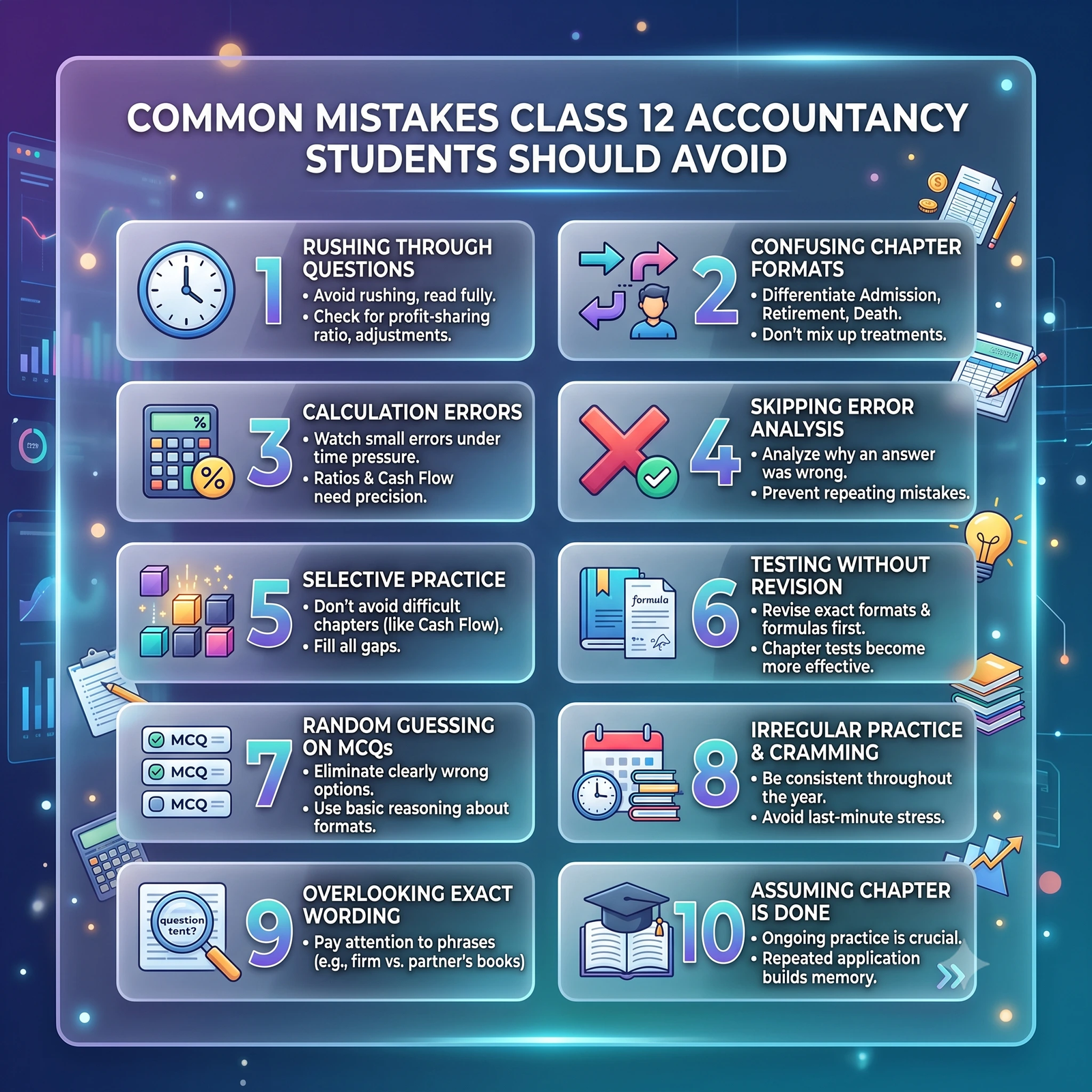
- Rushing through the question without reading it fully. In Accountancy, missing a single given detail, such as the profit-sharing ratio or an adjustment mentioned in passing, can lead to a completely wrong answer even when your method is correct.
- Confusing formats between similar chapters, such as mixing up the treatment used in admission of a partner with the one used in retirement or death of a partner.
- Making small calculation errors under time pressure, especially in chapters like Accounting Ratios and Cash Flow Statement, where one wrong figure changes the final answer.
- Skipping the explanation after getting a question wrong. Simply noting that the answer was incorrect and moving on means you are likely to repeat the same mistake in your next test or in the exam.
- Practicing only the chapters you already feel confident about, while avoiding ones that feel more difficult, such as Cash Flow Statement. This creates gaps that show up later in full-length papers.
- Attempting a chapter test before revising its exact formats and formulas, which usually leads to a lower score that does not truly reflect your understanding.
- Treating options as random guesses rather than eliminating clearly wrong choices first. In most Accountancy MCQs, at least one or two options can be ruled out through basic reasoning about the format.
- Not practicing regularly and instead attempting a large number of tests only in the final weeks before the board exam, which leaves little time to work on the weak chapters a test reveals.
- Overlooking the exact wording of a question, such as whether it asks for the treatment "in the books of the firm" or from a specific partner's point of view, which can completely change which side of an account an item belongs on.
- Assuming that once a chapter is completed in class, no further practice is needed. Accountancy formats are learned properly only through repeated application and a chapter read once but never tested is easy to forget by the time board exams arrive.
Why Use Aspirations Institute MCQ Tests?
Aspirations Institute has been working in school education and exam preparation for more than 22 years and the MCQ Tests portal is built around that classroom experience. Rather than offering generic question banks, the Class 12 Accountancy tests are organised chapter by chapter, in line with how the subject is actually taught and examined.
The combination of chapter-wise tests, instant results, written explanations and performance analytics is designed to support a genuine study routine, not just a one-time quiz. Whether you are using the free tests to get started or exploring premium access for the remaining chapters, the goal remains the same: to help you practice Accountancy in a structured, exam-focused way and become clear about where you stand before your board exams.
Because the tests are organised by a team that has been involved in school education since 2004, the questions are written with an understanding of how CBSE Class 12 Accountancy is actually taught in the classroom, rather than being generic questions collected from unrelated sources.
Final Call To Action
Pick a chapter you have recently studied and see how well you have understood it.
Frequently Asked Questions
1. Are free Class 12 Accountancy MCQ tests available on this page?
Yes, selected chapter tests such as Accounting for Partnership: Basic Concepts and Accounting Ratios may be available for free, letting Class 12 students try the chapter-wise format, instant results and explanations before deciding whether to explore premium tests for chapters like Cash Flow Statement.
2. Do the tests include answer explanations?
Yes, every chapter test comes with answer explanations, so when you get a question wrong on a topic such as goodwill treatment or cash flow classification, you can see the correct treatment or formula and understand exactly why the option you chose was not right.
3. Are the tests organised chapter-wise?
Yes, the Class 12 Accountancy tests are organised chapter by chapter, covering partnership accounting, company accounts and financial statement analysis topics such as Accounting Ratios and Cash Flow Statement and most chapters have more than one test, so you can use one for initial practice and another for revision.
4. Do I need to sign in to attempt these tests?
Selected free chapter tests can usually be attempted without signing in, which lets you try the format for a chapter such as Accounting for Share Capital first. Premium tests generally require you to sign in and hold an active plan, which may cover Accountancy alone or along with other Class 12 subjects.
5. Can I attempt these tests on my mobile phone?
Yes, the Class 12 Accountancy MCQ tests can be attempted on a mobile phone, tablet or computer, so you can fit in a quick chapter test, such as one on Accounting Ratios, whenever you find a short gap in your day, whether at school, at home or while travelling.
6. Is there negative marking in these tests?
Negative marking may apply to some Class 12 Accountancy chapter tests, so it is best to check the specific instructions before you attempt one. This matters especially in numerical-heavy chapters like Accounting Ratios, where you may want to think carefully before guessing between two closely worded options.
7. How should I use my test results to improve?
Use your results to identify chapters or formats where you are making repeated mistakes, such as confusing goodwill treatment in admission and retirement and revise those specific areas before reattempting a test. Noting down the exact reason for each mistake also helps you build a quick-reference list for revision.
8. Are these tests useful for last-minute revision before the board exam?
Yes, chapter-wise tests are a useful way to revise Class 12 Accountancy actively closer to the board exam, since attempting questions on chapters such as Cash Flow Statement or Accounting Ratios and reviewing the explanations checks your actual understanding rather than only rereading notes one more time.
9. What happens to premium test access after my plan ends?
Once your premium plan expires, access to the premium chapter tests covered under that plan comes to an end, though any free tests on the page remain available as before. If you want to keep practicing chapters such as company accounts, you would need to renew or choose another plan.
10. Are the questions based on the Class 12 Accountancy syllabus?
Yes, the tests are organised around the chapters typically covered in the Class 12 Accountancy syllabus, including partnership and company accounts topics, so the practice stays closely aligned with what you are actually studying in school and preparing for in your board exams.