Class 12 Economics MCQ Test Online – Chapter-Wise Practice
Introduction
Class 12 Economics is usually split into two parts, Microeconomics and Macroeconomics and each part introduces its own set of concepts, diagrams and terms. It is common for students to feel comfortable with one part and noticeably weaker in the other, simply because the two are taught somewhat separately and use different vocabulary. Reading through both halves of the textbook does not always reveal this imbalance clearly.
A Class 12 Economics MCQ test online is a direct way to check exactly where you stand, chapter by chapter, across both Microeconomics and Macroeconomics. Instead of only rereading definitions and diagrams, you attempt real questions on a specific chapter, see your score immediately and go through explanations for anything you got wrong.
This page offers chapter-wise Economics MCQ tests for Class 12 on the Aspirations Institute MCQ Tests portal, covering topics from both parts of the syllabus. You can pick a chapter you have recently studied, attempt a test, check your result at once and revisit the concepts behind any mistakes. Practiced consistently through the year, this cycle of testing and reviewing builds a much steadier grasp of Economics than passive revision closer to your board exams.
Because Economics has many closely related terms, such as different types of demand or different measures of national income, chapter-wise MCQ practice is particularly useful for training you to tell such terms apart clearly, well before your actual exam does.
Quick Page Summary
- Class: 12
- Subject: Economics
- Test Format: Chapter-wise MCQ tests covering Microeconomics and Macroeconomics
- Instant Results: Yes
- Answer Explanations: Available
- Performance Analytics: Available
- Free Tests: Selected chapter tests may be available at no cost
- Premium Tests: Additional chapter tests available with sign-in and an active plan
What Can Students Practice?
On this page, you can practice Class 12 Economics MCQ tests chapter by chapter. The chapters currently covered include:
- Indian Economy on the Eve of Independence
- Indian Economy 1950–1990
- Liberalisation, Privatisation and Globalisation
- Human Capital Formation in India
- Rural Development
- Employment: Growth, Informalisation and Other Issues
- Environment and Sustainable Development
- Comparative Development Experiences of India and Its Neighbours
- Excess Demand and Deficient Demand
- Aggregate Demand and Related Concepts
- Basic Concepts of Macroeconomics
- Circular Flow of Income
- Government Budget and the Economy
- Income Determination and Multiplier
- Money
- Banking
- National Income and Related Aggregates
- Measurement of National Income
- Balance of Payments
- Foreign Exchange Rate
This list spans both the Indian Economic Development portion and the Macroeconomics portion of the syllabus and each topic has its own chapter test, letting you focus on one at a time instead of mixing the two parts together.
Indian Economy on the Eve of Independence, Indian Economy 1950–1990, and Liberalisation, Privatisation and Globalisation form a connected sequence describing how the Indian economy has changed over time, so it helps to test them in this order to see the progression clearly. Human Capital Formation in India, Rural Development, Employment, Environment and Sustainable Development, and Comparative Development Experiences of India and Its Neighbours are more descriptive chapters with distinct terms and examples, so testing each on its own helps prevent the specific details of one chapter from blending into another.
On the Macroeconomics side, Basic Concepts of Macroeconomics and Circular Flow of Income lay the foundation, while National Income and Related Aggregates, and Measurement of National Income introduce several related aggregates that are easy to confuse without focused practice. Excess Demand and Deficient Demand, Aggregate Demand and Related Concepts, and Income Determination and Multiplier are closely linked numerical and diagram-based topics, so attempting their chapter tests one after another can help you see how they connect. Money and Banking, Government Budget and the Economy, and Balance of Payments and Foreign Exchange Rate round out the syllabus and are well suited to a chapter test closer to your board exams, since each involves specific terms that are worth confirming you remember accurately.
Why MCQ Practice Is Important
Economics MCQ practice does something that simply rereading a chapter cannot fully achieve. It requires you to read a statement or short scenario, decide which concept, term or relationship it represents and select the correct option, often while ruling out one or two options that use closely related terminology.
This is very close to what board exams actually expect, since Economics questions frequently test whether you can apply a concept, such as identifying a type of unemployment or reading a demand curve correctly, rather than simply define a term. Regular MCQ practice builds exactly this application skill.
Chapter-wise practice also builds speed. Economics has many specific terms and formulas, particularly in the Macroeconomics chapters dealing with national income and the multiplier and it is common to understand a concept but take time to recall the exact term or formula that fits a given question. Timed MCQ practice trains you to recall this information more quickly and confidently.
MCQ tests are also one of the clearest ways to discover which chapters you are genuinely weak in. It is easy to feel confident about a chapter like National Income and Related Aggregates after one reading, only to find through a test that you consistently confuse two similar aggregates or their formulas. Identifying this early through chapter-wise practice gives you time to revisit the specific concept, rather than discovering the gap during your board exam.
There is also a confidence element. Economics can feel like two separate subjects joined together and some students feel stronger in one part than the other without realising it clearly. Attempting chapter tests regularly across both Microeconomics and Macroeconomics and watching your scores improve over a few months, gives you concrete evidence of where you genuinely stand.
Finally, since Economics questions often use diagrams, such as demand and supply curves, MCQ practice that includes diagram-based questions trains you to read and interpret these diagrams quickly, which is exactly the skill full-length exam questions eventually reward.
There is also a particular value in testing the Indian Economic Development chapters and the Macroeconomics chapters separately rather than together. The two portions of the syllabus use different styles of question: the Indian Economic Development chapters lean more on factual and descriptive recall about policies and trends, while the Macroeconomics chapters lean more on numerical relationships and diagrams. Attempting chapter tests one part at a time helps you notice which style of question you personally find harder, so you can adjust how much time you spend revising each part rather than assuming your preparation is even across the whole subject.
Main Features Of The Online Tests
The Class 12 Economics tests on this page are built around a few features that support genuine practice:
- Chapter-Wise Tests: Each chapter, across both Microeconomics and Macroeconomics, has its own test, so you can practice a topic in full once you have finished studying it.
- Instant Results: Your score is shown as soon as you submit the test, so you know immediately how you performed.
- Answer Explanations: For questions you get wrong, explanations are provided so you understand why a particular option is correct and others are not.
- Performance Analytics: Your attempts are tracked over time, which can help you notice patterns, such as a chapter or an entire part of the syllabus where your score consistently lags behind the other.
- Free and Premium Access: A number of chapter tests are available for free, which lets you try the format before deciding whether to explore premium tests for the remaining chapters.
How To Use The Tests Effectively
Attempting tests one after another without a plan will not help you as much as using them thoughtfully. Here is a simple approach that works well for most students:
- Finish studying a chapter properly first, including its key terms, diagrams and formulas, before attempting its test. Testing yourself before this only leads to unnecessary frustration.
- Quickly revise the important terms, diagrams and formulas from that chapter. For example, before the National Income and Related Aggregates test, make sure you remember the different aggregates and how they relate to each other. Before the Government Budget test, revise the types of budget deficit.
- Attempt the chapter test within a reasonable time limit, without checking your notes. The goal is to see what you can genuinely recall and apply on your own.
- Check your score as soon as you finish, but look closely at which specific questions you got wrong rather than only the final number.
- Go through the explanations for every incorrect answer. Understand why the correct option is right and specifically why the option you chose, though it may sound similar, was wrong.
- If you notice a repeating pattern, such as confusing two similar national income aggregates or two types of unemployment, go back to that specific section of your textbook before moving on.
- After a few days, reattempt the same chapter's test to check whether your understanding has genuinely improved.
Following this cycle consistently across both parts of the syllabus, rather than testing yourself only occasionally, is what actually builds strong exam readiness through the year.
It also helps to keep a short, personal record of your scores as you progress, noting separately how you are doing in Microeconomics-related chapters compared to Macroeconomics-related ones. Over a few months, this record shows you clearly which part of the syllabus needs more attention, so your revision closer to the board exam can be targeted rather than spread thinly across everything.
A useful habit alongside this record is to note down, next to each low score, whether the mistake was a factual one, such as forgetting a term or a report's finding, or a conceptual one, such as misreading a diagram or a numerical relationship. Since the two parts of the Economics syllabus tend to demand different kinds of preparation, separating your mistakes this way makes it much easier to decide whether you need more reading and recall practice or more diagram and numerical practice in the weeks before your board exam.
Simple Study Plan
| Stage | What to Do | Purpose |
| Before the test | Revise the chapter's key terms, diagrams and formulas. | Refresh your memory before applying it under test conditions. |
| During the test | Attempt the chapter test within the given time. | Practice working at exam-like speed and focus. |
| Right after the test | Review every mistake and read the explanation for it. | Understand the correct concept, not just the correct answer. |
| Weekly revision | Reattempt tests for chapters covered so far, across both parts of the syllabus. | Retain concepts and catch topics that need more work. |
| Before the board exam | Attempt tests across all the chapters in both parts. | Get a realistic sense of your overall preparation. |
A study plan like this works best when you follow it steadily through the term, rather than trying to cover the entire syllabus in the final weeks before an exam.
Free And Premium Test Access
Selected chapter tests on this page may be available for free, letting you try the format for a few chapters without needing to sign in or subscribe to anything.
Beyond these, more chapter-wise tests are available as premium content. Premium tests generally require you to sign in and have an active plan, which may cover Economics alone or Economics along with other Class 12 subjects, depending on what you choose. Since the specific tests marked free and the plan options can change from time to time, it is best to check the current details directly on the page rather than relying on any fixed figure.
Whether you start with the free tests or move to premium access, the underlying format stays the same: chapter-based MCQs with instant results and explanations.
Who Should Attempt These Tests?
- Students who have just finished studying a Class 12 Economics chapter and want to check their understanding immediately.
- Students preparing for CBSE board exams who want structured, chapter-wise revision rather than random practice.
- Students who feel stronger in one part of the syllabus, Microeconomics or Macroeconomics and want to balance their preparation.
- Students who want to identify their weak chapters early in the year, rather than discovering them close to the board exams.
- Parents who want their child to follow a structured, trackable practice routine at home.
- Self-study students who do not have access to regular tuition and want a reliable way to test their own progress.
Common Mistakes Students Should Avoid
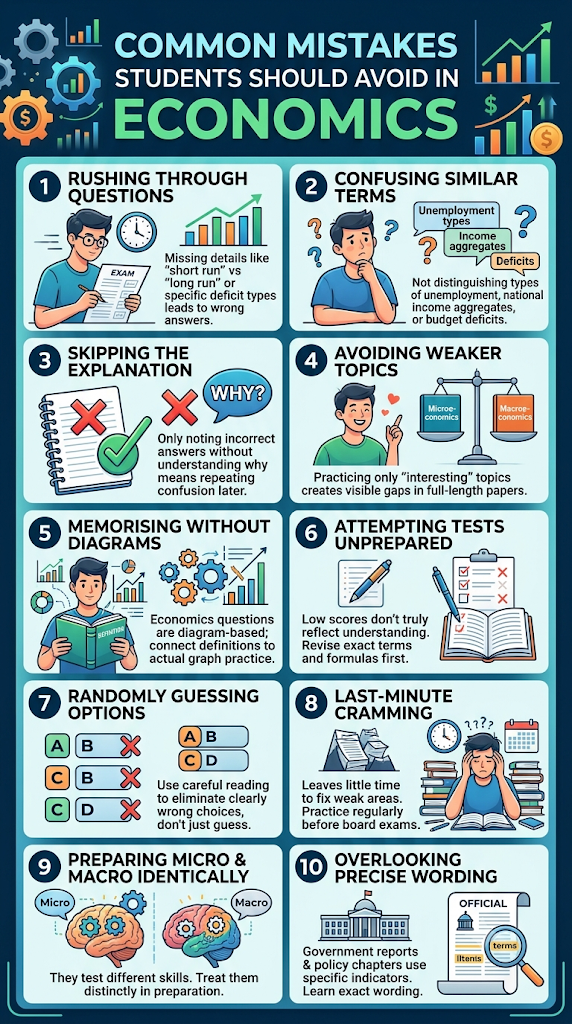
- Rushing through the question without reading it fully. In Economics, missing a small detail such as whether a question refers to the short run or long run, or to a specific type of deficit, can lead to a completely wrong answer.
- Confusing similar terms, such as different types of unemployment, different national income aggregates, or different types of budget deficit.
- Skipping the explanation after getting a question wrong. Simply noting that the answer was incorrect and moving on means you are likely to repeat the same confusion later.
- Practicing only the part of the syllabus you find more interesting, whether Microeconomics or Macroeconomics, while avoiding the other. This creates a visible gap in full-length papers that cover both.
- Memorising definitions without practicing how they connect to diagrams, since many Economics questions in this subject are diagram-based.
- Attempting a chapter test before revising its exact terms and formulas, which usually leads to a lower score that does not truly reflect your understanding.
- Treating options as random guesses instead of eliminating clearly wrong choices first through careful reading of each option.
- Not practicing regularly and instead attempting a large number of tests only in the final weeks before the board exam, which leaves little time to work on the weak chapters a test reveals.
- Assuming that Microeconomics and Macroeconomics can be prepared the same way. The two parts test somewhat different skills and treating them identically often means one part quietly stays weaker than the other until it shows up in a full-length paper.
- Overlooking the specific wording used in government reports and policy-related chapters, such as the precise terms used to describe employment or development indicators, which Economics questions sometimes test quite literally.
Why Use Aspirations Institute MCQ Tests?
Aspirations Institute has been working in school education and exam preparation for more than 22 years and the MCQ Tests portal is built around that classroom experience. Rather than offering generic question banks, the Class 12 Economics tests are organised chapter by chapter, in line with how the subject is actually taught and examined.
The combination of chapter-wise tests, instant results, written explanations and performance analytics is designed to support a genuine study routine, not just a one-time quiz. Whether you are using the free tests to get started or exploring premium access for the remaining chapters, the goal remains the same: to help you practice Economics in a structured, exam-focused way and become clear about where you stand before your board exams.
Because the tests are organised by a team that has been involved in school education since 2004, the questions are written with an understanding of how CBSE Class 12 Economics is actually taught in the classroom, rather than being generic questions collected from unrelated sources.
Final Call To Action
Pick a chapter you have recently studied and see how well you have understood it.
Frequently Asked Questions
1. Are free Class 12 Economics MCQ tests available on this page?
Yes, selected chapter tests such as Indian Economy 1950-1990 and Basic Concepts of Macroeconomics may be available for free, letting Class 12 students try the chapter-wise format across both Microeconomics and Macroeconomics before deciding whether to explore premium tests for the remaining chapters, such as National Income and Related Aggregates.
2. Do the tests include answer explanations?
Yes, every chapter test comes with answer explanations, so when you choose a wrong option on a question about a term, aggregate or diagram, you can see why the correct option is right and why the others, though worded similarly, do not actually match what the question is asking.
3. Are the tests organised chapter-wise?
Yes, the tests are organised chapter by chapter, covering both the Indian Economic Development portion, such as Rural Development and Human Capital Formation in India and the Macroeconomics portion, such as Money, Banking, and National Income and Related Aggregates, so you can practice each part separately instead of mixing the two together.
4. Do I need to sign in to attempt these tests?
Selected free chapter tests can usually be attempted without signing in, which lets you try the format for a chapter such as Basic Concepts of Macroeconomics first. Premium tests generally require you to sign in and hold an active plan, which may cover Economics alone or along with other Class 12 subjects.
5. Can I attempt these tests on my mobile phone?
Yes, the Class 12 Economics MCQ tests can be attempted on a mobile phone, tablet or computer, so you can fit in a quick chapter test, such as one on Money and Banking or Rural Development, whenever you find a short gap in your day, whether at school, at home or while travelling.
6. Is there negative marking in these tests?
Negative marking may apply to some Class 12 Economics chapter tests, so it is best to check the specific instructions before you attempt one. This matters especially in numerical and diagram-based Macroeconomics chapters, such as Income Determination and Multiplier, where guessing between two closely worded options can lower your score.
7. How should I use my test results to improve?
Use your results to identify chapters or terms where you are making repeated mistakes, such as confusing similar national income aggregates or types of unemployment and note whether the mistake was factual or conceptual, then revise those specific areas before reattempting a test.
8. Are these tests useful for last-minute revision before the board exam?
Yes, chapter-wise tests are a useful way to revise Class 12 Economics actively closer to the board exam, since attempting questions across both Microeconomics and Macroeconomics chapters and reviewing the explanations checks your actual understanding rather than only rereading definitions and diagrams one more time.
9. What happens to premium test access after my plan ends?
Once your premium plan expires, access to the premium chapter tests covered under that plan comes to an end, though any free tests on the page remain available as before. If you want to keep practicing remaining chapters, such as the Macroeconomics ones, you would need to renew or choose another plan.
10. Are the questions based on the Class 12 Economics syllabus?
Yes, the tests are organised around the Microeconomics and Macroeconomics topics typically covered in the Class 12 Economics syllabus, so the practice stays closely aligned with what you are actually studying in school and preparing for in your board exams.