Class 8 Science MCQ Test Online – Chapter-Wise Practice
Introduction
Class 8 Science covers a wide and varied set of ideas, from the basic method of scientific investigation, to the invisible world of microorganisms, to forces, pressure, light and the planet we live on. Some chapters, like Health: The Ultimate Treasure, connect directly to everyday life, while others, like Electricity: Magnetic and Heating Effects or Light, Mirrors and Lenses, need careful, step-by-step understanding before the concepts feel natural.
Reading a chapter once and following the explanations in class often gives a feeling of understanding that does not always hold up when you try to apply the same idea to a new example. Science at this level increasingly asks you to reason through a situation rather than just recall a fact, whether that means predicting what happens when two solutions are mixed or explaining why a particular storm forms. This is exactly where a Class 8 Science MCQ test online helps.
This page offers chapter-wise Science MCQ tests for Class 8 on the Aspirations Institute MCQ Tests portal. You can pick a chapter you have recently studied, attempt a timed test, see your result at once and review explanations for anything you got wrong. Building this habit of testing, reviewing and revising across the term gives you a far more reliable sense of your preparation than simply re-reading the textbook closer to your exam.
Many students feel they know a chapter well right after a class discussion, since the explanation made sense at the time. School exams, however, often rephrase a concept or place it in a new situation and this is exactly where gaps in understanding tend to show up. Attempting chapter-wise MCQs regularly exposes you to this kind of variation early, in a low-pressure setting, so the actual exam question does not feel unfamiliar. Whether you are comfortable with the physics-related chapters like forces and pressure but unsure about chemistry topics like the nature of matter, or the other way round, this page lets you focus your practice exactly where it is needed.
Quick Page Summary
- Class: 8
- Subject: Science
- Test Format: Chapter-wise MCQ tests, with more than one test available for most chapters
- Instant Results: Yes, with explanations
- Answer Explanations: Available
- Performance Analytics: Available
- Free Tests: Selected chapter tests may be available at no cost
- Premium Tests: Additional tests available with sign-in and an active plan
What Can Students Practice?
On this page, you can practice Class 8 Science MCQ tests chapter by chapter. The chapters currently covered include:
- Exploring the Investigative World of Science
- The Invisible Living World Beyond Our Naked Eye
- Health: The Ultimate Treasure
- Electricity: Magnetic and Heating Effects
- Exploring Forces
- Pressure, Winds, Storms and Cyclones
- Particulate Nature of Matter
- Nature of Matter
- The Amazing World of Solutes, Solvents and Solutions
- Light, Mirrors and Lenses
- Keeping Time with the Skies
- How Nature Works
- Our Home Earth: A Unique Life-Sustaining Planet
For most of these chapters, more than one test is available, letting you attempt one soon after finishing the chapter and another closer to your exam as a revision check. This spread means you can focus your practice on exactly where you need it, rather than treating every chapter the same way.
Exploring the Investigative World of Science works well as a starting point, since it introduces the way of thinking used across the rest of the book. The Invisible Living World Beyond Our Naked Eye and Health: The Ultimate Treasure are closely linked biology chapters, since understanding microorganisms feeds directly into understanding health and disease. Electricity: Magnetic and Heating Effects, Exploring Forces, and Pressure, Winds, Storms and Cyclones sit together as physics-based chapters, each rewarding diagram and situation-based practice rather than plain recall. Particulate Nature of Matter, Nature of Matter, and The Amazing World of Solutes, Solvents and Solutions form a chemistry sequence and testing them in order helps you build up from the basic particle model to more specific behaviour like dissolving and solutions. Light, Mirrors and Lenses is calculation and diagram-heavy, so a topic-focused test closer to your exam can help you get comfortable with ray diagrams before attempting a full-chapter version. Keeping Time with the Skies, How Nature Works and Our Home Earth: A Unique Life-Sustaining Planet are usually covered later in the term and connect Earth science with the idea of natural balance, making them well suited to a revision-focused test once the rest of the syllabus feels familiar.
Why MCQ Practice Is Important
Science MCQ practice does something that reading alone cannot do. It forces you to actually apply a concept to a specific situation within a limited time, rather than only recognising a fact when you see it stated in the textbook.
A well-designed Science MCQ rarely asks you to just repeat a definition. It usually places a concept in context, such as describing an everyday scenario and asking which force is acting, or presenting a mixture and asking you to identify whether it forms a solution or a suspension. This kind of application-based thinking develops only through repeated, active practice, not through re-reading notes.
Regular MCQ practice also builds speed. Many students understand a concept well but still lose marks in a school test because they take too long deciding between two close options, or because they misread a key detail in the question. Practicing chapter-wise tests under a time limit trains you to work at a steady, careful pace instead of rushing or freezing on a tricky question.
Perhaps most importantly, MCQ tests reveal your weak chapters clearly. It is easy to feel confident about a topic after a class discussion, but a test will quickly show whether you can apply what you learned independently. Reviewing your mistakes carefully after each test, rather than moving on immediately, is one of the most effective ways to convert a shaky chapter into a strong one before your exams.
There is also a psychological benefit that is easy to underestimate. Exam pressure often comes from uncertainty about your own preparation rather than the difficulty of the syllabus itself. When you have already attempted several chapter-wise tests through the term and seen your scores improve, you walk into your exam with real evidence of your progress instead of just hoping you remember enough.
Because Class 8 Science spans biology, physics, chemistry and earth science within a single syllabus, MCQ practice also trains you to move comfortably between very different styles of reasoning, from a diagram-based physics question to a process-based biology one, which mirrors how a full exam paper is usually structured.
Science at this stage also starts connecting ideas across chapters more than before, such as how the particulate nature of matter explains behaviour you later see in solutions, or how forces and pressure together explain why storms and cyclones form the way they do. MCQ practice that follows the order chapters were taught in, rather than jumping around at random, helps you notice these connections instead of treating each chapter as a completely separate block of information to memorise.
Main Features Of The Online Tests
The Class 8 Science tests on this page are built around a few features that make practice more useful:
- Chapter-Wise Tests: You can choose a test based on the chapter you have just studied, so your practice stays connected to your classroom progress.
- Multiple Tests Per Chapter: Several chapters have more than one test, letting you attempt one after your first reading and another closer to your exam.
- Instant Results: As soon as you submit a test, your score is shown immediately, without waiting for anyone to check your paper.
- Answer Explanations: For questions you get wrong, explanations are provided so you understand the correct reasoning, not just the correct option.
- Performance Analytics: Your attempts are tracked over time, helping you notice patterns, such as a chapter you consistently find harder than others.
- Free and Premium Access: A number of chapter tests may be available for free, so you can try the format before deciding whether to explore premium tests for wider coverage.
How To Use The Tests Effectively
Attempting tests one after another without a plan will not help you as much as using them thoughtfully. Here is a simple approach that works well for most students:
- Finish studying the chapter properly first, including diagrams, activities and examples from your textbook, before attempting a test on it.
- Quickly revise the key terms and processes from that chapter. Before a Light, Mirrors and Lenses test, for instance, make sure you remember how reflection and refraction work with different types of mirrors and lenses.
- Attempt the chapter-wise test within a reasonable time limit, without checking your notes, so the result genuinely reflects what you can recall and apply.
- Check your score as soon as you finish and look closely at which specific questions you got wrong rather than only the final number.
- Go through the explanation for every incorrect answer. Understand why the correct option is right and just as importantly, why the option you chose was wrong.
- If you notice a repeated type of mistake, such as confusing the particulate nature of matter with the specific behaviour of solutions, go back to that specific concept before moving on.
- After a few days, reattempt a test on the same chapter, especially if a second test is available, to check whether your understanding has genuinely improved.
Following this cycle across all the chapters, rather than testing yourself only occasionally, is what actually builds strong exam readiness. It also helps to keep a simple, personal record of your scores as you move through the syllabus. This does not need to be elaborate; even a short note of the chapter, the date you attempted it and your score is enough to show you, over a few months, which chapters need more attention and which ones you have genuinely mastered.
For chapters that involve diagrams, such as Electricity: Magnetic and Heating Effects or Light, Mirrors and Lenses, it can help to sketch the relevant diagram from memory before attempting the test, rather than only reading the description again. This small step often reveals gaps in understanding that plain reading does not.
It also helps to space out chapters that deal with related ideas, such as Particulate Nature of Matter and Nature of Matter, rather than attempting both tests in one sitting. Giving yourself a short gap between the two allows the first idea to settle before you build the next one on top of it, which usually leads to fewer mix-ups than trying to absorb both at once.
Simple Study Plan
| Stage | What to Do | Purpose |
| Before the test | Revise the chapter's key terms, diagrams and processes. | Refresh your memory before applying it under test conditions. |
| During the test | Attempt the chapter-wise test within the given time. | Practice working at exam-like speed and focus. |
| Right after the test | Review every mistake and read the explanation for it. | Understand the correct reasoning, not just the correct answer. |
| Weekly revision | Reattempt tests for chapters covered so far. | Retain concepts and catch topics that need more work. |
| Before the school exam | Attempt tests across all chapters covered in class. | Get a realistic sense of your overall preparation. |
A study plan like this works best when you follow it consistently through the term, rather than trying to complete all chapters in the final weeks before your exam.
Free And Premium Test Access
Selected chapter tests on this page may be available for free, giving you a chance to try the format for a few chapters without needing to sign in or subscribe to anything.
Beyond these, more chapter-wise tests are available as premium content. Premium tests generally require you to sign in and have an active plan, which may cover Science alone or Science along with other Class 8 subjects, depending on what you choose. Since plans and their duration can change from time to time, it is best to check the current options directly on the page rather than relying on any fixed figure.
Whether you start with the free tests or move to premium access, the underlying format stays the same: chapter-based MCQs with instant results and explanations.
Who Should Attempt These Tests?
- Students who have just finished studying a Class 8 Science chapter and want to check their understanding immediately.
- Students preparing for CBSE school exams who want structured, chapter-wise revision rather than random practice.
- Students who want to identify their weak chapters early in the year, rather than discovering them close to the exams.
- Students who find diagram-based chapters like electricity, light or forces harder to retain and want repeated, focused practice.
- Parents who want their child to follow a structured, trackable practice routine at home.
- Self-study students who do not have access to regular tuition and want a reliable way to test their own progress.
Common Mistakes Students Should Avoid
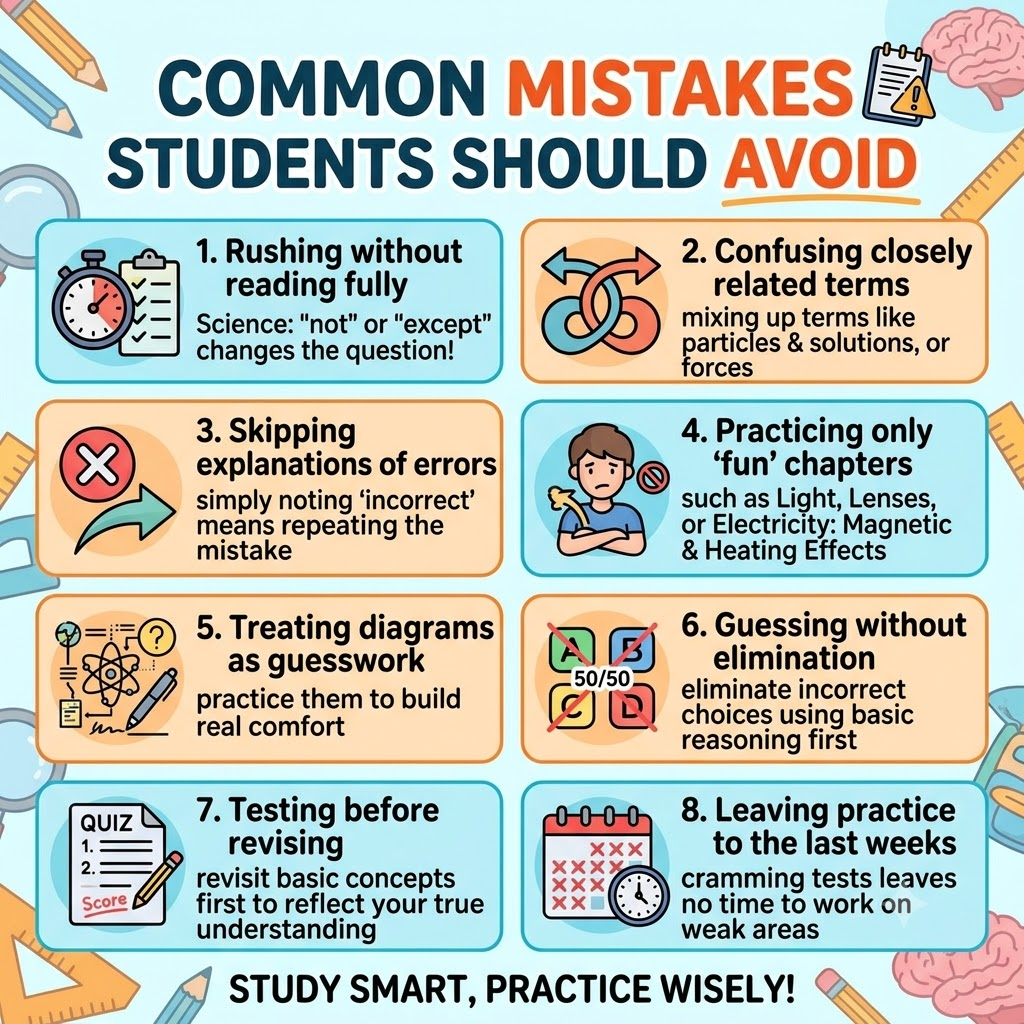
- Rushing through the question without reading it fully. In Science, a single word such as "not" or "except" can completely change what a question is asking.
- Confusing closely related terms, such as mixing up the particulate nature of matter with specific properties of solutions, or confusing different types of forces.
- Skipping the explanation after getting a question wrong. Simply noting that the answer was incorrect and moving on means the same mistake is likely to repeat.
- Practicing only the chapters you find more interesting, while avoiding ones that feel harder, such as Light, Mirrors and Lenses or Electricity: Magnetic and Heating Effects. This creates gaps that show up later in full-length papers.
- Treating diagram-based questions as guesswork rather than practicing a few carefully to build real comfort with them.
- Choosing an option purely by guessing rather than first eliminating choices that are clearly incorrect based on basic reasoning.
- Attempting a chapter's test before revising its basic concepts, which usually leads to a lower score that does not truly reflect your understanding.
- Not practicing regularly and instead attempting a large number of tests only in the last few weeks before the exam, which leaves little time to work on the weak chapters a test reveals.
Why Use Aspirations Institute MCQ Tests?
Aspirations Institute has been working in school education and exam preparation for more than 22 years and the MCQ Tests portal is built around that classroom experience. Rather than offering generic question banks, the Class 8 Science tests are organised chapter by chapter, in line with how the subject is actually taught in school.
The combination of chapter-wise tests, instant results, written explanations and performance analytics is designed to support a genuine study routine, not just a one-time quiz. Whether you are using the free tests to get started or exploring premium access for more complete coverage, the goal remains the same: to help you practice Science in a structured, exam-focused way and become clear about where you stand before your school tests and exams.
Because the tests are organised by the same team that has been involved in school education since 2004, the questions are written with an understanding of how Class 8 Science is actually taught in the classroom, rather than being generic questions collected from unrelated sources. This makes the practice more relevant to what you are likely to face in your school tests, whether the question checks a straightforward fact or asks you to apply a concept to a new situation.
Final Call To Action
Pick a chapter you have recently studied and see how well you have understood it.
Frequently Asked Questions
1. Are free Class 8 Science MCQ tests available on this page?
Yes, selected chapter tests may be available for free, alongside additional premium tests, so you can try the format on a chapter such as Exploring Forces or Health: The Ultimate Treasure, see instant results and read explanations before deciding whether wider premium coverage is needed.
2. Do the tests include answer explanations?
Yes, explanations are provided for every question, so when you get a physics, chemistry or biology-based question wrong, such as one on electricity, matter or microorganisms, you can understand the correct reasoning rather than only knowing which option was right.
3. Are the tests organised chapter-wise?
Yes, tests are organised chapter by chapter, covering topics like forces, electricity, matter, solutions, light and earth science and many chapters have more than one test, so you can attempt an early check and a later revision test on the same chapter separately.
4. Do I need to sign in to attempt these tests?
Selected free tests can usually be attempted without signing in, which is useful if you just want to check one chapter quickly. Premium tests generally require you to sign in and have an active plan, since they cover a wider set of chapters and additional tests per topic.
5. Can I attempt these tests on my mobile phone?
Yes, the Class 8 Science MCQ tests are designed to work on a mobile phone, tablet or computer, so you can attempt a short chapter test whenever you have a few free minutes, whether that is right after school, during a break, or while revising at home.
6. Is there negative marking in these tests?
Negative marking may apply to some of the Class 8 Science tests, though this can vary from one chapter test to another. Since the rule is not the same across every test, it is best to check the specific instructions shown before you start attempting it.
7. How should I use my test results to improve?
Look closely at which chapters, such as light and lenses, electricity or solutions, you got wrong rather than only your overall score, read the explanation for each mistake carefully and revise that specific chapter's diagrams and processes before reattempting a similar test a few days later.
8. Are these tests useful for last-minute revision before the school exam?
Yes, reattempting tests across chapters is particularly useful for quick revision closer to the exam, since a short test on a chapter like Pressure, Winds, Storms and Cyclones shows you immediately which concepts still need work, without having to reread the whole textbook chapter again.
9. What happens to premium test access after my plan ends?
Once your premium plan expires, access to the additional chapter tests included under that plan generally ends, since premium access depends on an active subscription. The free chapter tests on the page, however, remain available regardless of your plan status, so you can continue practicing those selected chapters.
10. Are the questions based on the CBSE Class 8 Science syllabus?
Yes, the tests are designed around the topics covered in the Class 8 Science syllabus, including chapters on forces, electricity, matter and solutions, light, and earth and life sciences, so the practice reflects what is actually taught in class and tested in school exams.
Related Tests You Might Like
- Class 8 Maths MCQ Tests
- Class 8 Social Science MCQ Tests
- Class 7 Science MCQ Tests
- Aspirations Institute Tuition Classes