Class 8 Social Science MCQ Test Online – Chapter-Wise Practice
Introduction
Class 8 Social Science brings together geography, history, civics and economics and the topics get noticeably more layered than in earlier classes. You move from understanding natural resources and how India's political map has changed, to the rise of the Marathas and the colonial era, to how universal franchise and the parliamentary system actually work, along with the basic idea of factors of production in economics. Each of these areas asks for a different kind of thinking, from geographical reasoning to historical sequencing to understanding how governance is structured.
Simply reading through these chapters once rarely gives a lasting grasp of the material. Social Science at this level often expects you to connect an idea across chapters, such as linking how a region's resources shaped its economy, or how earlier systems of governance compare with the parliamentary system introduced later. This is exactly where a Class 8 Social Science MCQ test online becomes genuinely useful.
This page offers chapter-wise Social Science MCQ tests for Class 8 on the Aspirations Institute MCQ Tests portal. You can select a chapter you have recently studied, attempt a timed test, view your result immediately and go through explanations for anything you got wrong. Repeating this cycle regularly through the term is a practical way to keep a content-heavy subject like this fresh in your memory, rather than trying to revise everything at once close to your exam.
Many students feel confident about a chapter right after a class discussion, since the explanation made sense at the time. Exam questions, however, often connect a fact to its cause or effect, or ask you to apply an idea to a scenario slightly different from the textbook. A chapter-wise MCQ test online exposes you to this kind of question early, in a low-pressure setting, so that a differently worded exam question does not catch you off guard. Whether you find the history chapters like The Rise of the Marathas and The Colonial Era in India more comfortable than the civics chapters, or the other way round, this page lets you direct your practice exactly where it is needed.
Quick Page Summary
- Class: 8
- Subject: Social Science
- Test Format: Chapter-wise MCQ tests, with more than one test available for most chapters
- Instant Results: Yes, with explanations
- Answer Explanations: Available
- Performance Analytics: Available
- Free Tests: Selected chapter tests may be available at no cost
- Premium Tests: Additional tests available with sign-in and an active plan
What Can Students Practice?
On this page, you can practice Class 8 Social Science MCQ tests chapter by chapter. The chapters currently covered include:
- Natural Resources and Their Use
- Reshaping India's Political Map
- The Rise of the Marathas
- The Colonial Era in India
- Universal Franchise and India's Electoral System
- The Parliamentary System: Legislature and Executive
- Factors of Production
For most of these chapters, more than one test is available, letting you attempt one soon after finishing the chapter and another closer to your exam as a revision check. This spread means you can match your practice to exactly where you need it, rather than treating the whole subject as one uniform block of content.
Natural Resources and Their Use works well as a starting point, since it sets up the connection between geography and how regions develop economically, which is useful background for Factors of Production later. Reshaping India's Political Map, The Rise of the Marathas and The Colonial Era in India form the historical thread of the syllabus and attempting their tests in this order helps you keep the sequence of events clear rather than mixing up periods and rulers. Universal Franchise and India's Electoral System, and The Parliamentary System: Legislature and Executive sit together as civics chapters that build directly on each other, since understanding how citizens vote connects naturally to understanding how the elected government is then structured and functions. Factors of Production, being more economics-focused, is often best tested once the rest of the syllabus feels familiar, since it introduces a different way of thinking about resources, production and the economy compared to the history and civics chapters.
Why MCQ Practice Is Important
Social Science MCQ practice does something plain reading cannot do on its own. It forces you to recall a fact, name or process independently, under a small amount of time pressure, rather than simply recognising it when you see it printed in the textbook.
A well-framed Social Science MCQ often asks you to apply an idea to a new example rather than just recall it directly. Instead of asking you to name a factor of production, it may describe a business scenario and ask which factor is being referred to, or describe a historical event and ask you to identify the ruler or period it belongs to. This kind of application is exactly what many school exams expect and it develops only through repeated, active practice.
Regular MCQ practice also builds a sense of pace. Many students know a chapter reasonably well but still lose marks in an exam because they take too long deciding between two close options, particularly with questions involving similar-sounding rulers, dates or regions. Timed chapter tests help you get comfortable working at a steady pace instead of getting stuck on a single tricky question.
MCQs are also one of the clearest ways to reveal which chapters genuinely need more attention. It is easy to feel confident about a chapter simply because it was discussed thoroughly in class, but a test will quickly show whether you can recall and apply its details independently. Reviewing your incorrect answers properly, rather than moving straight to the next chapter, is what turns a shaky topic into a dependable one before your exam.
There is a quieter benefit here too, particularly for a subject with this much content. Exam pressure often comes from not knowing exactly how much of the syllabus you actually remember. When you have already attempted several chapter tests through the term and tracked your improvement, you walk into your exam with real evidence of your preparation instead of a vague hope that you have covered everything.
Because Social Science blends geography, history, civics and economics, MCQ practice also trains you to switch between different styles of reasoning within a single sitting, which mirrors how a real exam paper is usually structured, moving from a resource-based geography question to a historical one to a civics-based one without much warning.
This mix of subject areas also means that marks lost in one part of the syllabus, such as a mixed-up date in the history chapters, cannot usually be made up for by strength in another part, such as civics, since school papers typically allot separate marks to each chapter. Practicing each chapter through its own dedicated MCQ test, rather than assuming a general sense of the subject will carry you through, helps protect your marks across the full syllabus instead of only the parts you find naturally interesting.
Main Features Of The Online Tests
The Class 8 Social Science tests on this page are built around a few features that make practice more useful:
- Chapter-Wise Tests: You can choose a test based on the chapter you have studied, keeping your practice aligned with your classroom progress.
- Multiple Tests Per Chapter: Several chapters have more than one test, letting you attempt one after your first reading and another closer to your exam.
- Instant Results: As soon as you submit a test, your score is shown immediately, without waiting for anyone to check your paper.
- Answer Explanations: For questions you get wrong, explanations are provided so you understand the correct reasoning behind the answer.
- Performance Analytics: Your attempts are tracked over time, helping you notice patterns, such as a period of history or a civics concept you consistently find harder.
- Free and Premium Access: A number of chapter tests may be available for free, giving you a chance to try the format before deciding whether to explore premium tests for wider coverage.
How To Use The Tests Effectively
Attempting tests one after another without a plan will not help as much as using them thoughtfully. Here is a simple approach that works well for most students:
- Finish studying the chapter properly first, including any maps, timelines or diagrams given in your textbook, before attempting a test on it.
- Quickly revise the key names, places, terms and processes from that chapter. For a history chapter, jot down the sequence of events; for Factors of Production, revise the definitions of each factor.
- Attempt the chapter test within a reasonable time limit, without checking your notes, so the result genuinely reflects what you remember and understand.
- Check your score as soon as you finish and look closely at which specific questions you got wrong rather than only the final number.
- Go through the explanation for every incorrect answer. Understand why the correct option is right, not just that your choice was wrong.
- If you notice a repeated type of mistake, such as confusing two rulers, regions or economic terms, go back to that specific part of the chapter before moving on.
- After some days, reattempt a test on the same chapter, especially if a second test is available, to check whether your recall has genuinely improved.
Following this cycle across all the chapters, rather than testing yourself only occasionally, is what actually builds strong exam readiness in a subject with this much content to remember. It also helps to keep a simple, personal log of the chapters you have tested and your score each time. This need not be detailed; a short note of the chapter, the date and the score is enough to show you, over a few months, which topics need revisiting and which ones you have genuinely mastered.
A useful habit specific to this subject is to keep a small timeline for the history chapters and a short list of definitions for the civics and economics chapters. Referring back to these before attempting a test, rather than only reading the chapter text again, often helps you recall details far more reliably during the actual test.
It also helps to space out the two history chapters, The Rise of the Marathas and The Colonial Era in India, rather than attempting their tests back to back. Since both deal with related periods and figures, giving yourself a short gap in between, along with a quick review of your notes, reduces the chance of mixing up details from one period with the other.
Simple Study Plan
| Stage | What to Do | Purpose |
| Before the test | Revise the chapter's key names, dates, terms and processes. | Refresh your memory before applying it under test conditions. |
| During the test | Attempt the chapter test within a set time limit. | Practice steady, focused recall under mild time pressure. |
| Right after the test | Review every mistake and read its explanation. | Understand the correct reasoning, not just the correct answer. |
| Weekly revision | Reattempt tests for chapters covered so far. | Retain details and catch topics that need more work. |
| Before the school exam | Revisit tests across geography, history, civics and economics chapters. | Get a realistic, subject-wide sense of your preparation. |
A study plan like this works best when followed consistently through the term, rather than trying to cover the whole syllabus in the final days before an exam.
Free And Premium Test Access
Selected chapter tests on this page may be available for free, giving you a chance to try the format for a few chapters without needing to sign in or subscribe to anything.
Beyond these, additional chapter-wise tests are available as premium content. Premium tests generally require you to sign in and have an active plan, which may cover Social Science alone or Social Science along with other Class 8 subjects, depending on what you choose. Since plans and their duration can change from time to time, it is best to check the current options directly on the page rather than relying on any fixed figure.
Whether you begin with the free tests or move on to premium access, the underlying format stays the same: chapter-based MCQs with instant results and explanations.
Who Should Attempt These Tests?
- Students who have just finished studying a Class 8 Social Science chapter and want to check their understanding immediately.
- Students preparing for school tests who want structured, chapter-wise revision rather than random practice.
- Students who find it hard to keep track of names, dates, places and economic terms and want repeated practice to make these stick.
- Students who want to identify their weak chapters early in the year, rather than close to the exams.
- Parents who want their child to follow a structured, trackable practice routine at home.
- Self-study students who do not have access to regular tuition and want a reliable way to test their own progress.
Common Mistakes Students Should Avoid
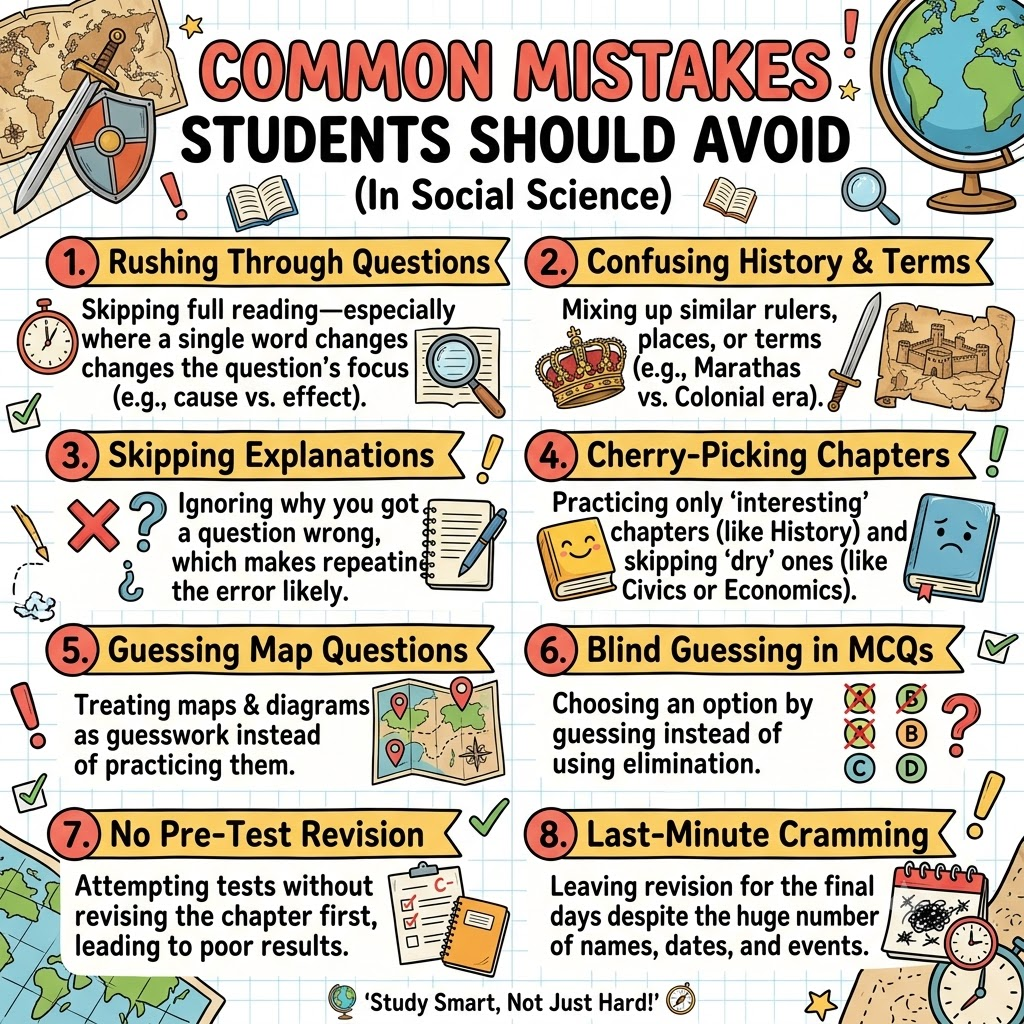
- Rushing through the question without reading it fully, which is especially risky in Social Science, where a single word can change whether a question is about a cause, an effect or an example.
- Confusing similar-sounding rulers, places or terms, particularly across the history chapters covering the Marathas and the colonial era.
- Skipping the explanation after getting a question wrong. Noting only that the answer was incorrect, without understanding why, means the mistake is likely to repeat.
- Practicing only the chapters you find more interesting, such as history, while avoiding ones that feel drier, like civics or economics-based chapters. This creates gaps that show up later.
- Treating map-based or diagram-based questions as guesswork instead of practicing a few carefully to build familiarity with them.
- Choosing an option purely by guessing rather than first eliminating choices that are clearly incorrect based on what you already know.
- Not revising the chapter before attempting its test, which usually leads to a lower score that does not truly reflect your understanding.
- Leaving all Social Science revision for the last few days before the exam, given how many names, dates and terms the subject involves across geography, history, civics and economics.
Why Use Aspirations Institute MCQ Tests?
Aspirations Institute has been working in school education and exam preparation for more than 22 years and the MCQ Tests portal is built around that classroom experience. Rather than offering generic question banks, the Class 8 Social Science tests are organised chapter by chapter, in line with how geography, history, civics and economics are actually taught in school.
The combination of chapter-wise tests, instant results, written explanations and performance analytics is designed to support a genuine study routine rather than a one-time quiz. Whether you use the free tests to get started or explore premium access for wider coverage, the goal stays the same: helping you keep track of a subject with many moving parts and understand where you stand before your school tests and exams.
Because the tests are organised by the same team that has been involved in school education since 2004, the questions are framed with an understanding of how Class 8 Social Science is actually taught in the classroom, rather than being generic questions collected from unrelated sources. This makes the practice more relevant to how your school is likely to test you, whether the question checks a simple fact or asks you to connect an idea across two chapters.
Final Call To Action
Pick a chapter you have recently studied and see how well you have understood it.
Frequently Asked Questions
1. Are free Class 8 Social Science MCQ tests available on this page?
Yes, selected chapter tests may be available for free, alongside additional premium tests, so you can try the format on a geography, history, civics or economics chapter, see instant results and read explanations before deciding whether premium access suits your revision needs.
2. Do the tests include answer explanations?
Yes, explanations are provided for every question, so when you get a question wrong on a ruler, an election process or a factor of production, you can understand the correct reasoning behind the answer, rather than only knowing which option was right and moving on.
3. Are the tests organised chapter-wise?
Yes, tests are organised chapter by chapter, covering natural resources, history chapters on the Marathas and the colonial era, civics chapters on elections and parliament, and economics and several chapters have more than one test, letting you revise a topic twice if needed.
4. Do I need to sign in to attempt these tests?
Selected free tests can usually be attempted without signing in, which is useful if you just want to check one chapter quickly. Premium tests generally require you to sign in and have an active plan, since they cover additional chapters and extra tests per topic.
5. Can I attempt these tests on my mobile phone?
Yes, the Class 8 Social Science MCQ tests are designed to work on a mobile phone, tablet or computer, so you can attempt a short chapter test whenever you have a few free minutes, whether that is right after school, during a break, or while revising at home.
6. Is there negative marking in these tests?
Negative marking may apply to some of the Class 8 Social Science tests, though this can vary from one chapter test to another. Since the rule is not the same across every test, it is best to check the specific instructions shown before you start attempting it.
7. How should I use my test results to improve?
Look closely at which chapters, such as a period of history, an electoral concept or a factor of production, you got wrong rather than only your overall score, read the explanation for each mistake carefully and revise that specific chapter's names, dates and terms before reattempting a similar test.
8. Are these tests useful for revising before a school exam?
Yes, reattempting tests on chapters already covered in class is a useful way to check your readiness before an exam, since a short test quickly shows whether you still remember key names, dates and terms, rather than only recognising them when you see them printed in the textbook.
9. What happens to premium test access after my plan ends?
Once your premium plan expires, access to the additional chapter tests included under that plan generally ends, since premium access depends on an active subscription. The free chapter tests on the page, however, remain available regardless of your plan status, so you can continue practicing those selected chapters.
10. Are the questions based on the CBSE Class 8 Social Science syllabus?
Yes, the tests are designed around the topics covered in the Class 8 Social Science syllabus, including natural resources, the Marathas and the colonial era in history, universal franchise and the parliamentary system in civics, and factors of production in economics, matching what is taught in class.
Related Tests You Might Like
- Class 8 Science MCQ Tests
- Class 8 English MCQ Tests
- Class 8 Maths MCQ Tests
- Class 7 Social Science MCQ Tests
- Aspirations Institute Tuition Classes