JEE Main Maths MCQ Test Online – Chapter-Wise Practice
Introduction
JEE Main is one of the most competitive engineering entrance exams in India and Maths is often the subject that decides how comfortably a student clears the cutoff. Unlike school exams, JEE Main Maths questions rarely ask you to simply apply a formula in the way it appears in a textbook example. They usually combine two or three ideas from different topics into a single question and you have very little time per question to work through that combination.
This is exactly why a JEE Main Maths MCQ test online is so valuable during preparation. Reading through solved examples in a book shows you the method once it has already been worked out. An MCQ test, on the other hand, hands you the raw question and expects you to identify the right approach yourself, under a time limit, with an answer that has to match one of the given options exactly. That difference, between recognising a method and applying it independently, is what actually gets tested in JEE Main.
This page offers Maths MCQ tests for JEE Main preparation, organised by topic, so you can practice a specific area once you have studied it, get your result immediately and go through the working for any question you got wrong. Used consistently through your preparation, this pattern of practicing a topic and then reviewing your mistakes is one of the most reliable ways to build real exam-day speed and accuracy.
JEE Main Maths draws from a wide range of topics, spanning algebra, calculus, coordinate geometry, trigonometry, vectors and three-dimensional geometry, probability and statistics, among others. Because these topics connect with each other so closely, a weak understanding in one, say complex numbers or conic sections, tends to quietly affect your performance in later, seemingly unrelated questions as well. Topic-wise MCQ practice lets you catch and fix these gaps early, rather than discovering them for the first time in a full-length mock test.
Quick Page Summary
- Exam: JEE Main
- Subject: Maths
- Test Format: Topic-wise MCQ tests, with additional tests expected to be added over time
- Instant Results: Yes
- Answer Explanations: Available for selected tests
- Performance Tracking: Supported through your test attempts
- Free Tests: Selected topic tests may be available at no cost
- Premium Tests: Additional tests available with sign-in and an active plan
- Who Should Use: JEE Main aspirants preparing Maths
What Can Students Practice?
On this page, you can practice JEE Main Maths MCQ tests built around specific topics. As an example of the format, a full-length test on Coordinate Geometry is currently available on the page at no cost, giving you a sense of the question style, timing and difficulty level you can expect.
JEE Main Maths, as an exam subject, is generally understood to be organised around topics such as:
- Sets, Relations and Functions
- Complex Numbers and Quadratic Equations
- Matrices and Determinants
- Permutations and Combinations
- Binomial Theorem and Sequences and Series
- Limits, Continuity and Differentiability
- Integral Calculus and Differential Equations
- Coordinate Geometry
- Three-Dimensional Geometry
- Vector Algebra
- Trigonometry
- Statistics and Probability
This list reflects the topics commonly covered in JEE Main Maths preparation rather than a confirmed list of every test currently live on this page, since the portal may add topic-wise tests over time. It is worth checking the page directly to see the exact set of topics and tests available when you visit.
Algebra-based topics such as Complex Numbers and Quadratic Equations, Matrices and Determinants, and Permutations and Combinations are often a good starting point, since they build the reasoning skills needed for calculus later on. Calculus topics, covering limits, differentiability, integration and differential equations, tend to carry significant weight in JEE Main and are worth revisiting through multiple rounds of topic-wise practice rather than a single pass. Coordinate Geometry, Three-Dimensional Geometry and Vector Algebra share a good deal of common reasoning around points, lines and planes, so practicing them close together can help you see the connections between them. Trigonometry, and Statistics and Probability, often left for later in a study schedule, are just as scoring when practiced through focused, topic-wise tests rather than left until the final weeks before the exam.
Why MCQ Practice Is Important For JEE Main
JEE Main Maths gives you very little time per question and MCQ practice is what actually trains you to work at that pace without sacrificing accuracy.
When you attempt an MCQ, you have to read the question, decide which concept or formula applies, work through the calculation and match your final answer to one of four options, often within a minute or two. This is very different from working through a solved example at your own pace in a textbook. Regular topic-wise practice builds the specific skill of recognising, quickly, which method a question is asking for, which is often the biggest time-saver in JEE Main.
MCQ practice also builds calculation stamina. JEE Main Maths questions frequently involve multiple steps of algebraic manipulation before you reach the final answer and a single small error partway through can lead you to a completely wrong option. Practicing topic-wise tests regularly, rather than only solving a few questions occasionally, trains you to carry out these multi-step calculations accurately under time pressure.
Perhaps most usefully, MCQ tests reveal your weak topics clearly. It is common to feel reasonably confident about a topic like Complex Numbers or Vector Algebra after reading through the theory, but a timed test often shows a different picture, particularly when a question combines that topic with another one. Reviewing your test results topic by topic, rather than only looking at your overall score, is what helps you use your remaining preparation time on the areas that actually need it.
There is also a specific advantage to MCQ practice for an exam like JEE Main, where the answer key format means you either select the correct option or you do not, with no credit for a partially correct method. This is quite different from a school exam where showing the right approach can still earn some marks even with a calculation slip. Practicing MCQs regularly trains you to double-check your final answer against the given options before committing to it, catching errors that a purely descriptive approach to studying would not expose.
Finally, because JEE Main rewards speed as much as understanding, topic-wise MCQ practice, attempted under a time limit, is what helps you build the instinct for which approach to try first on a given question, rather than testing every method you know before finding the right one. This instinct, built through repeated timed practice, is often what separates a comfortable attempt from a rushed one on the actual exam day.
Main Features Of The Online Tests
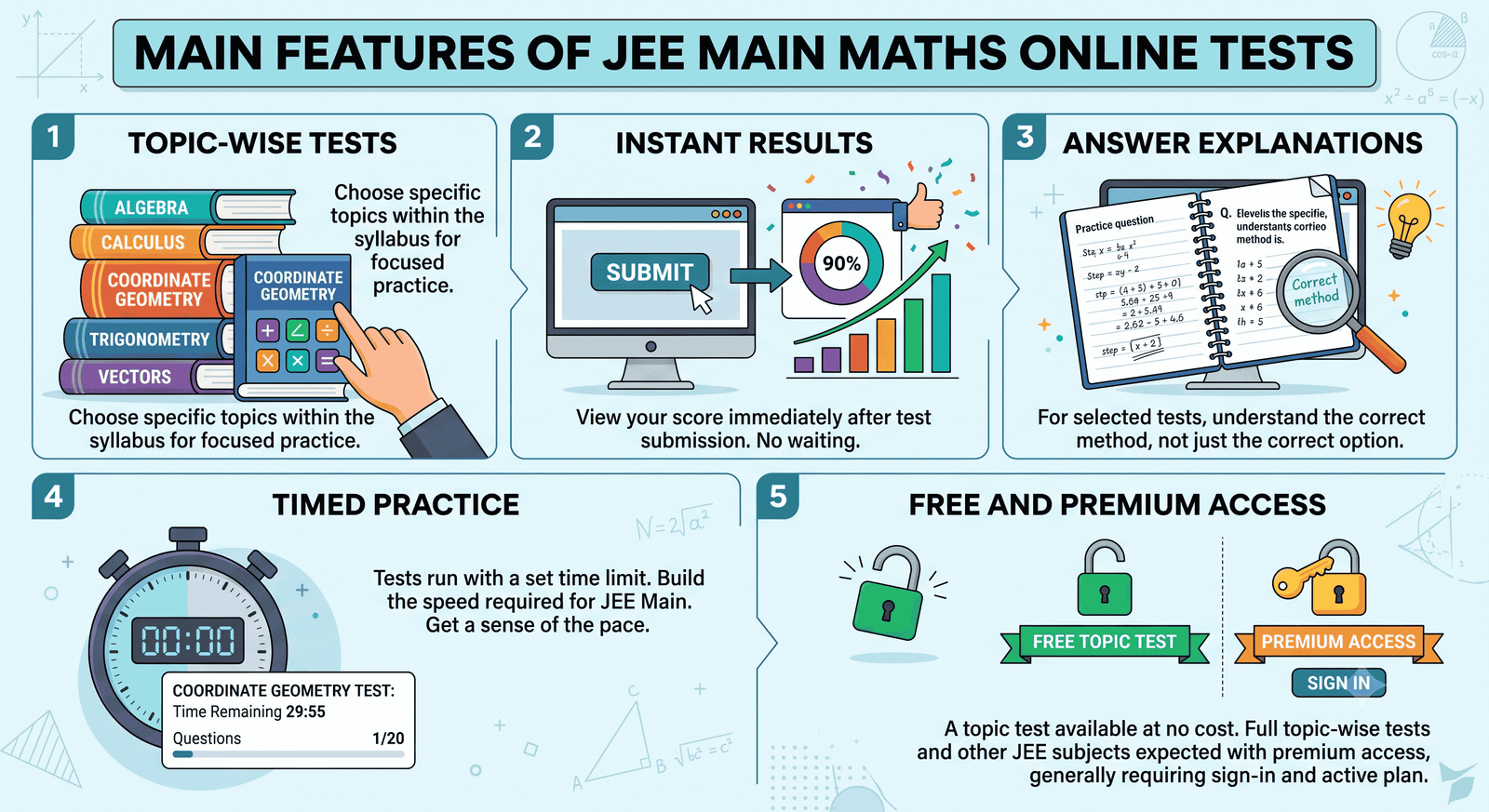
The JEE Main Maths tests on this page are built around a few features designed to support focused, exam-ready practice:
- Topic-Wise Tests: You can choose a specific topic within the Maths syllabus and attempt a focused test on it, rather than working through a mixed set of unrelated questions.
- Instant Results: Your score is shown as soon as you submit a test, without any wait.
- Answer Explanations: For selected tests, explanations are provided so you understand the correct method, not just the correct option.
- Timed Practice: Tests run within a set time limit, which helps you build the speed JEE Main requires. The Coordinate Geometry test currently on the page, for instance, runs for a set duration with a fixed number of questions, giving you a sense of the pace to expect.
- Free and Premium Access: A topic test is available at no cost on this page and further topic-wise tests, along with tests for other JEE Main subjects, are expected to be available through premium access, which generally requires you to sign in and hold an active plan.
How To Use The Tests Effectively
Attempting tests without a plan will not help you as much as using them thoughtfully. Here is an approach that works well for most JEE Main Maths aspirants:
- Finish studying a topic properly first, including its standard formulas, solved examples and common variations, before attempting a test on it.
- Quickly revise the key formulas for that topic. Before a Coordinate Geometry test, for example, make sure you remember the standard equations of lines, circles and conics, along with the formulas for distance, section and angle between lines.
- Attempt the test within the given time limit, without referring to your notes, so you can see honestly what you can recall and apply independently.
- Check your score as soon as you finish, but do not stop at the number. Note down which specific questions you got wrong and why.
- Go through the working for every incorrect answer, where explanations are available. Understand the correct method step by step, rather than only noting the final answer.
- If you notice a recurring type of mistake, such as a sign error in coordinate geometry formulas or a wrong substitution in calculus, revisit that specific concept in your notes before attempting another test.
- After some time, reattempt a test on the same topic to check whether your speed and accuracy have genuinely improved, rather than assuming they have.
Following this cycle across each topic in the syllabus, rather than testing yourself only occasionally, is what builds real exam readiness for JEE Main Maths. It also helps to keep a simple, personal record of your scores and the time you took on each test. Over a few weeks, this record shows you which topics you consistently finish quickly and accurately and which ones still slow you down, so your revision in the final stretch before the exam can focus on exactly those areas rather than being spread evenly across the whole syllabus.
Simple Study Plan
| Stage | What to Do | Purpose |
| Before the test | Revise the topic's formulas and solved examples. | Refresh your memory before applying it under test conditions. |
| During the test | Attempt the topic-wise test within the given time. | Build the speed and accuracy JEE Main requires. |
| Right after the test | Review every mistake and go through the working for it. | Understand the correct method, not just the correct answer. |
| Weekly revision | Reattempt tests for topics covered so far. | Retain concepts and catch topics that need more work. |
| Before the JEE Main exam | Attempt tests across as many topics as the page offers. | Get a realistic sense of your overall readiness and pace. |
A study plan like this works best when followed consistently through your preparation, rather than compressed into the final weeks before JEE Main.
Free And Premium Test Access
A topic-wise test, currently covering Coordinate Geometry, is available on this page at no cost, letting you try the test format, timing and question style before deciding how to structure the rest of your preparation.
Beyond this, further topic-wise Maths tests, along with tests for other JEE Main subjects, are expected to be available through premium access. Premium tests generally require you to sign in and hold an active plan, which may cover Maths alone or Maths along with other JEE Main subjects, depending on what you choose. Since plans, their duration and pricing can change from time to time, it is best to check the current options directly on the page rather than relying on any fixed figure.
Whether you start with the free test or move to premium access, the underlying format stays the same: topic-based MCQs with instant results and explanations provided where available.
Who Should Attempt These Tests?
- JEE Main aspirants who have just finished studying a Maths topic and want to check their understanding immediately.
- Students who want timed, topic-wise practice rather than only working through a textbook at their own pace.
- Students who want to identify which Maths topics slow them down before attempting full-length mock tests.
- Students preparing alongside school or coaching classes who want additional structured practice.
- Parents who want their child to follow a trackable practice routine at home.
- Self-study students preparing for JEE Main Maths without regular coaching support.
Common Mistakes Students Should Avoid
- Rushing through a question without reading it fully. In JEE Main Maths, missing a condition such as a restriction on a variable can lead to a technically correct calculation that still does not match any of the given options.
- Making small calculation errors under time pressure, particularly in multi-step topics like calculus and coordinate geometry, where one slip early in the working changes the final answer.
- Confusing formulas between closely related topics, such as mixing up standard results from Vector Algebra and Three-Dimensional Geometry, since both deal with similar ideas expressed differently.
- Skipping the working after getting a question wrong and simply noting the correct option, which means the same type of mistake is likely to repeat in a later test or in the exam.
- Practicing only the topics that already feel comfortable, while avoiding ones that feel harder, such as probability or certain areas of calculus, which leaves gaps that show up later in full-length attempts.
- Attempting a topic-wise test before revising the relevant formulas, which usually leads to a lower score that does not reflect genuine understanding of the topic.
- Treating every question as requiring a full calculation from scratch, instead of first checking whether an option can be eliminated through estimation or a quick property check, which can save valuable time in the exam.
- Leaving MCQ practice for the last few weeks before JEE Main instead of practicing steadily through preparation, which leaves very little time to work on the weak topics a test reveals.
Why Use Aspirations Institute MCQ Tests?
Aspirations Institute has been working in school education and exam preparation for more than 22 years and the MCQ Tests portal is built around that classroom and exam-preparation experience. Rather than offering a generic question bank, the JEE Main Maths tests on this page are organised topic by topic, in a way designed to match how the subject is actually studied and tested.
The combination of topic-wise tests, instant results and explanations for selected questions is designed to support a genuine, ongoing preparation routine rather than a one-time quiz. Whether you begin with the free Coordinate Geometry test to understand the format or explore premium access as more topic-wise tests and other JEE Main subjects become available, the aim stays the same: to help you practice Maths for JEE Main in a structured, exam-focused way and become clear about where you stand as your preparation progresses.
Because the tests are organised by a team with a long-standing background in school education, the questions are framed with an understanding of how JEE Main Maths is actually asked, rather than being generic questions collected from unrelated sources. This makes your practice more directly useful, whether a question tests a single formula or combines two topics into one multi-step problem.
Final Call To Action
Pick a Maths topic you have recently studied and use a JEE Main Maths MCQ test to see how well you can apply it under timed conditions.
Frequently Asked Questions
1. Are free JEE Main Maths MCQ tests available on this page?
Yes, a full-length topic-wise test on Coordinate Geometry is currently available at no cost on this page, letting you experience the question style, timing and difficulty level of JEE Main Maths MCQs firsthand, while further topic-wise tests and other JEE Main subjects are expected to be added through premium access.
2. Do the tests include answer explanations?
Explanations are provided for selected tests, so you can understand the correct method rather than only the correct option, which matters in JEE Main Maths since a single wrong step in a multi-step calculation, such as one involving Coordinate Geometry or calculus, can lead to a completely wrong final answer.
3. Are the tests organised topic-wise?
Yes, the tests are organised around specific Maths topics, such as Coordinate Geometry, Complex Numbers and Quadratic Equations, and Limits, Continuity and Differentiability, which lets you focus your practice on one area at a time rather than working through a mixed set of unrelated questions covering the entire syllabus.
4. Do I need to sign in to attempt these tests?
The free Coordinate Geometry test currently available on this page can be attempted without signing in, letting you try the format right away. Premium tests, expected to cover further Maths topics and other JEE Main subjects, generally require you to sign in and hold an active plan.
5. Can I attempt these tests on my mobile phone?
Yes, since the tests are hosted on the Aspirations Institute MCQ Tests portal, you can attempt the Coordinate Geometry test, or any future topic-wise test added to this page, on a mobile phone, tablet or computer, making it easy to practice during a short break in your JEE Main preparation.
6. Is there negative marking in these tests?
Negative marking may apply to some tests, in line with the actual JEE Main exam pattern, though this can vary between individual tests, so it is best to check the specific instructions shown before you start a topic-wise test rather than assuming the same marking scheme applies to every one.
7. How should I use my test results to improve?
Use your results to identify topics or question types, such as a sign error in Coordinate Geometry or a wrong substitution in calculus, where you are making repeated mistakes, then revise those specific formulas and methods before reattempting the same topic-wise test to check whether your speed and accuracy improved.
8. Are these tests useful for building exam-day speed?
Yes, attempting topic-wise tests within a time limit, such as the Coordinate Geometry test currently on this page, is a practical way to build the pace JEE Main Maths requires, since the exam gives very little time per question and rewards students who can recognise the right method quickly.
9. What happens to premium test access after my plan ends?
Once a plan expires, access to the premium topic-wise Maths tests and other JEE Main subject tests covered under that plan ends, though the free Coordinate Geometry test on this page may remain available and you are free to renew or choose a different plan for continued access.
10. Are the questions based on the JEE Main Maths syllabus?
The tests are designed around topics commonly covered in JEE Main Maths preparation, such as algebra, calculus, coordinate geometry, trigonometry, vectors and three-dimensional geometry, and probability and statistics, with the current Coordinate Geometry test as an example of the format and further topic-wise tests expected to be added over time.