JEE Main Physics MCQ Test Online – Chapter-Wise Practice
Introduction
JEE Main is one of the most competitive engineering entrance exams in India and Physics is often the subject where preparation and actual exam performance drift apart the most. It is common to understand a concept clearly while reading a chapter, yet still struggle when the same concept appears inside a numerical problem that combines two or three ideas together, phrased in a way you have not seen before.
This is exactly why a JEE Main Physics MCQ test online is so useful during preparation. Reading a chapter and going through solved examples shows you how a concept works once the problem has already been set up for you. An MCQ test, on the other hand, gives you the raw problem and expects you to set it up yourself, work through the numbers and match your final answer to one of the given options, all within a short time limit. That gap, between understanding a concept and applying it independently under time pressure, is precisely what JEE Main Physics tests.
This page offers chapter-wise Physics MCQ tests for JEE Main preparation. You can choose a chapter you have studied, attempt a test within a set time, see your result as soon as you submit it and work through the explanations for any question you got wrong. Repeating this cycle across chapters, rather than only reading and re-reading your notes, is what builds genuine exam-day readiness in Physics.
JEE Main Physics is generally organised around mechanics, electricity and magnetism, optics, thermodynamics and modern physics, with each broad area made up of several individual chapters. Because these chapters build on each other, a shaky foundation in an early mechanics chapter often shows up later as difficulty in a chapter that assumes you already have that foundation in place. Chapter-wise MCQ practice lets you catch and correct this early, rather than discovering the gap for the first time in a full-length mock test.
Quick Page Summary
- Exam: JEE Main
- Subject: Physics
- Test Format: Chapter-wise MCQ tests, with multiple tests available for several chapters
- Instant Results: Yes
- Answer Explanations: Available for selected tests
- Performance Tracking: Supported through your test attempts
- Free Tests: Selected chapter tests are available at no cost
- Premium Tests: Additional tests available with sign-in and an active plan
- Who Should Use: JEE Main aspirants preparing Physics
What Can Students Practice?
On this page, you can practice JEE Main Physics MCQ tests chapter by chapter. The chapters currently covered include:
- Physical World, Units and Measurements
- Motion
- Laws of Motion
- Work, Energy and Power
- System of Particles and Rotational Motion
- Gravitation
For most of these chapters, more than one test is available, so you can attempt one soon after finishing the chapter and return to another one later for revision. Each test is built around a set number of questions within a fixed time limit, giving you a realistic sense of the pace JEE Main requires.
These six chapters together form the mechanics portion of the JEE Main Physics syllabus, which is often where a student's overall Physics score is decided, since later topics in a full JEE Main syllabus, such as electricity, magnetism and modern physics, frequently reuse the reasoning first built here. Physical World, Units and Measurements is a good starting point, since it establishes the basic conventions, such as dimensional analysis, that quietly show up in numerical problems across every later chapter. Motion and Laws of Motion follow naturally from each other, since the second builds directly on the first by introducing force as the cause of change in motion. Work, Energy and Power then reframes many of these same situations in terms of energy, which is often a faster way to solve a problem that looks complicated when approached through forces alone. System of Particles and Rotational Motion, and Gravitation extend these same core ideas, motion, force and energy, to rotating bodies and to bodies interacting at a distance, respectively.
Because the reasoning carries over from one chapter to the next in this way, attempting chapter-wise tests in the order they are typically taught, rather than jumping between unrelated chapters, tends to make each new test noticeably easier to approach.
Why MCQ Practice Is Important For JEE Main
JEE Main Physics gives you very little time per question and MCQ practice is what actually trains you to work at that pace without losing accuracy.
When you attempt a Physics MCQ, you first have to identify which concept or law the question is testing, since JEE Main questions rarely state this directly. You then have to set up the problem, work through the calculation and check your final answer against the given options, often within a minute or two. This is a very different skill from following a solved example in a textbook, where the setup has already been done for you.
Regular MCQ practice also builds calculation speed and confidence. Physics numericals often involve several steps, unit conversions and careful attention to signs and directions and a single small slip can lead you to a completely wrong option even when your understanding of the concept is correct. Practicing chapter-wise tests under a time limit trains you to carry out these calculations quickly and carefully, rather than rushing through them under exam pressure for the first time.
MCQ tests are also one of the clearest ways to find your weak chapters. It is common to feel confident about a chapter like Motion after reading through it, but a timed test often reveals gaps, particularly in questions that combine motion with forces, or forces with energy. Reviewing your test results chapter by chapter, rather than only checking your overall score, is what helps you direct your remaining preparation time to where it is actually needed.
There is also a specific reason MCQ practice matters for JEE Main Physics. The exam offers no credit for a partially correct method, unlike a school exam where showing the right approach can still earn some marks despite a calculation error. This means a vague, conceptual understanding of a chapter is not enough; you need to reach the exact numerical answer within the time given. Practicing MCQs regularly closes this gap between "I understand this concept" and "I can solve this problem correctly under exam conditions," which is exactly what JEE Main is designed to test.
Finally, because many JEE Main Physics questions combine two chapters into a single problem, such as a rotational motion question that also uses energy conservation, chapter-wise MCQ practice done early in your preparation, followed by mixed practice later, helps you build both the individual concepts and the ability to combine them, which is what the actual exam consistently demands.
Main Features Of The Online Tests
The JEE Main Physics tests on this page are built around a few features designed to support focused, exam-ready practice:
- Chapter-Wise Tests: You can choose a specific chapter, from Physical World, Units and Measurements through to Gravitation and attempt more than one test on several of these chapters as you move from an early attempt to a later revision.
- Instant Results: Your score is shown as soon as you submit a test, without any wait.
- Answer Explanations: For selected tests, explanations are provided so you understand the correct method, not just the correct option.
- Timed Practice: Each test runs within a set time limit and covers a fixed number of questions, which helps you build the pace JEE Main requires.
- Free and Premium Access: The first test for several chapters, including Physical World, Units and Measurements, Motion, Work, Energy and Power, and System of Particles and Rotational Motion, is available at no cost, so you can try the format before deciding whether to explore premium access for the remaining tests.
How To Use The Tests Effectively
Attempting tests one after another without any plan will not help you as much as using them thoughtfully. Here is an approach that works well for most JEE Main Physics aspirants:
- Finish studying a chapter properly first, including its formulas, standard derivations and solved examples, before attempting a test on it.
- Quickly revise the key formulas and standard results for that chapter. Before a Laws of Motion test, for example, be clear on the different types of forces and how to draw a free body diagram. Before a Gravitation test, revise the standard results for orbital velocity, escape velocity and time period.
- Attempt the chapter-wise test within the given time limit, without referring to your notes, so you can honestly see what you can recall and apply on your own.
- Check your score as soon as you finish, but do not stop at the number. Note which specific questions you got wrong and why.
- Go through the explanations for every incorrect answer, where available. Understand the correct method and setup, not just the final numerical answer.
- If you notice a recurring type of mistake, such as sign errors in Motion problems or confusion between torque and force in System of Particles and Rotational Motion, revisit that specific concept before attempting another test.
- After some time, reattempt a test on the same chapter to check whether your speed and accuracy have genuinely improved.
Following this cycle across all six chapters, rather than testing yourself only occasionally, is what actually builds exam readiness for JEE Main Physics. It also helps to keep a simple, personal record of your scores and the time you took for each test. Over a few weeks, this record shows you which chapters you consistently solve quickly and accurately and which ones still slow you down, so your revision closer to the exam can focus on exactly those chapters instead of being spread evenly across all of them.
Simple Study Plan
| Stage | What to Do | Purpose |
| Before the test | Revise the chapter's formulas, derivations and solved examples. | Refresh your memory before applying it under test conditions. |
| During the test | Attempt the chapter-wise test within the given time. | Build the speed and accuracy JEE Main requires. |
| Right after the test | Review every mistake and read the explanation for it. | Understand the correct method, not just the correct answer. |
| Weekly revision | Reattempt tests for chapters covered so far. | Retain concepts and catch chapters that need more work. |
| Before the JEE Main exam | Attempt tests across all six chapters, mixing earlier and later ones. | Get a realistic sense of your overall readiness and pace. |
A study plan like this works best when followed consistently through your preparation, rather than compressed into the final weeks before JEE Main.
Free And Premium Test Access
The first test for several chapters on this page, including Physical World, Units and Measurements, Motion, Work, Energy and Power, and System of Particles and Rotational Motion, is available at no cost, so you can try the format before deciding how to structure the rest of your practice.
Beyond these, additional chapter-wise tests are available as premium content. Premium tests generally require you to sign in and hold an active plan, which may cover Physics alone or Physics along with other JEE Main subjects, depending on what you choose. Since plans, their duration and pricing can change from time to time, it is best to check the current options directly on the page rather than relying on any fixed figure.
Whether you start with the free tests or move to premium access, the underlying format stays the same: chapter-based MCQs with instant results and explanations provided where available.
Who Should Attempt These Tests?
- JEE Main aspirants who have just finished studying a Physics chapter and want to check their understanding immediately.
- Students who want timed, chapter-wise practice rather than only working through a textbook at their own pace.
- Students who want to identify which mechanics chapters need more work before moving on to later topics in the syllabus.
- Students preparing alongside school or coaching classes who want additional structured practice.
- Parents who want their child to follow a trackable practice routine at home.
- Self-study students preparing for JEE Main Physics without regular coaching support.
Common Mistakes Students Should Avoid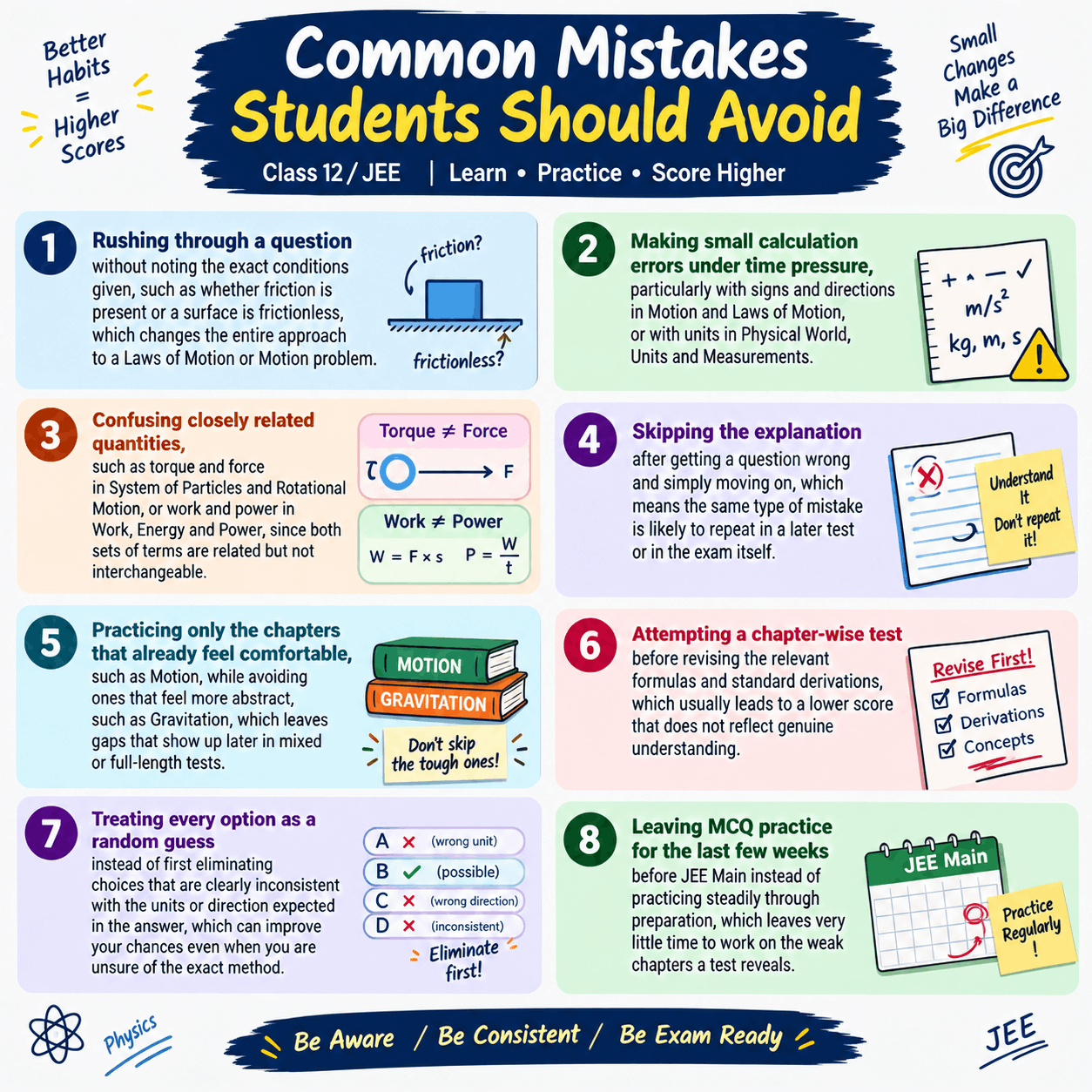
- Rushing through a question without noting the exact conditions given, such as whether friction is present or a surface is frictionless, which changes the entire approach to a Laws of Motion or Motion problem.
- Making small calculation errors under time pressure, particularly with signs and directions in Motion and Laws of Motion, or with units in Physical World, Units and Measurements.
- Confusing closely related quantities, such as torque and force in System of Particles and Rotational Motion, or work and power in Work, Energy and Power, since both sets of terms are related but not interchangeable.
- Skipping the explanation after getting a question wrong and simply moving on, which means the same type of mistake is likely to repeat in a later test or in the exam itself.
- Practicing only the chapters that already feel comfortable, such as Motion, while avoiding ones that feel more abstract, such as Gravitation, which leaves gaps that show up later in mixed or full-length tests.
- Attempting a chapter-wise test before revising the relevant formulas and standard derivations, which usually leads to a lower score that does not reflect genuine understanding.
- Treating every option as a random guess instead of first eliminating choices that are clearly inconsistent with the units or direction expected in the answer, which can improve your chances even when you are unsure of the exact method.
- Leaving MCQ practice for the last few weeks before JEE Main instead of practicing steadily through preparation, which leaves very little time to work on the weak chapters a test reveals.
Why Use Aspirations Institute MCQ Tests?
Aspirations Institute has been working in school education and exam preparation for more than 22 years and the MCQ Tests portal is built around that classroom and exam-preparation experience. Rather than offering a generic question bank, the JEE Main Physics tests on this page are organised chapter by chapter, in a way designed to match how mechanics is actually taught and built up, one chapter leading into the next.
The combination of chapter-wise tests, instant results and explanations for selected questions is designed to support a genuine, ongoing preparation routine rather than a one-time quiz. Whether you start with the free tests available for several chapters or explore premium access for wider chapter coverage, the aim stays the same: to help you practice Physics for JEE Main in a structured, exam-focused way and become clear about where you stand as your preparation progresses.
Because the tests are organised by a team with a long-standing background in school education, the questions are framed with an understanding of how JEE Main Physics is actually asked, rather than being generic questions collected from unrelated sources. This makes your practice more directly useful, whether a question tests a single formula or combines two related chapters into one multi-step numerical problem.
Final Call To Action
Pick a Physics chapter you have recently studied and use a JEE Main Physics MCQ test to see how well you can apply it under timed conditions.
Frequently Asked Questions
1. Are free JEE Main Physics MCQ tests available on this page?
Yes, the first test for several chapters, including Physical World, Units and Measurements, Motion, Work, Energy and Power, and System of Particles and Rotational Motion, is available at no cost, letting you try the format before deciding whether premium access is needed for the remaining chapter-wise tests, such as Gravitation.
2. Do the tests include answer explanations?
Explanations are provided for selected tests, so you can understand the correct method rather than only the correct option, which matters in JEE Main Physics since a single small slip in signs, units or direction can lead to a completely wrong final answer even when your concept is correct.
3. Are the tests organised chapter-wise?
Yes, the tests are organised chapter by chapter across the six mechanics chapters covered on this page, from Physical World, Units and Measurements to Gravitation and several chapters have more than one test available, so you can attempt an early test and a later one for revision.
4. Do I need to sign in to attempt these tests?
Selected free tests, such as the first test for Physical World, Units and Measurements, Motion, or Work, Energy and Power, can be attempted without signing in. Premium tests generally require you to sign in and hold an active plan, which may cover Physics alone or with other JEE Main subjects.
5. Can I attempt these tests on my mobile phone?
Yes, since the tests are hosted on the Aspirations Institute MCQ Tests portal, you can attempt any chapter-wise JEE Main Physics test on a mobile phone, tablet or computer, which makes it convenient to fit a focused mechanics practice session into a short break during your daily preparation schedule.
6. Is there negative marking in these tests?
Negative marking may apply to some tests, in line with the actual JEE Main exam pattern, though this can vary between individual chapter tests, so it is best to check the specific instructions shown before you start a test rather than assuming the same marking scheme applies to every chapter.
7. How should I use my test results to improve?
Use your results to identify chapters or question types, such as a sign error in Motion or confusion between torque and force in System of Particles and Rotational Motion, where you are making repeated mistakes, then revise those specific formulas before reattempting the chapter-wise test to check genuine improvement.
8. Are these tests useful for building exam-day speed?
Yes, attempting chapter-wise tests within a time limit is a practical way to build the pace JEE Main Physics requires, since each test on this page covers a fixed number of questions within a set duration, giving you a sense of how quickly you need to work on exam day.
9. What happens to premium test access after my plan ends?
Once a plan expires, access to the premium chapter-wise Physics tests covered under that plan ends, though the free tests on this page, such as the first test for Motion or Work, Energy and Power, may remain available and you can renew or choose a different plan for continued access.
10. Are the questions based on the JEE Main Physics syllabus?
The tests are designed around chapters commonly covered in JEE Main Physics preparation, currently spanning the six mechanics chapters of the syllabus, from Physical World, Units and Measurements through Gravitation, with topics such as electricity, magnetism and modern physics expected to be added as the portal expands its coverage.