JEE Main Chemistry MCQ Test Online – Chapter-Wise Practice
Introduction
Ask a few JEE Main aspirants where they lose marks in Chemistry and the answers sound alike: an exception that slipped their mind, a reaction product that was almost right, a mole calculation that went off by a factor of two. None of these is a failure of effort. They happen because knowing a chapter and answering questions from it against a clock are two different abilities, and only one of them grows by reading.
A JEE Main Chemistry MCQ test online trains the second ability. Every question arrives without a label telling you which concept it belongs to. You decide what is being asked, bring the right fact or method to mind, and settle on one option before time runs out. Do this chapter after chapter and you start to see how the exam really frames its questions, which is rarely the way a textbook states them.
The tests on this page are arranged chapter by chapter. Choose a chapter you have just finished, attempt a timed test, check your result the moment you submit, and read the explanations for whatever went wrong. Then move to the next chapter and repeat. A few weeks of this gives you a far more honest picture of your Chemistry than another round of rereading notes.
Chemistry for JEE Main is usually divided into Physical, Organic and Inorganic Chemistry, and each part behaves differently under test conditions. Physical Chemistry punishes careless arithmetic and unit handling. Organic Chemistry rewards students who understand why a reaction goes the way it does. Inorganic Chemistry rewards accurate memory of trends and properties. Testing chapter by chapter shows you which of the three is holding your score back.
Quick Page Summary
- Exam: JEE Main
- Subject: Chemistry
- Test Format: Online MCQ tests arranged chapter by chapter, with several tests for many chapters; topic-wise and mock tests are also part of the practice options
- Instant Results: Yes, as soon as you submit
- Answer Explanations: Available for all Questions of each test
- Performance Tracking: Based on your test attempts
- Free Tests: A selection of tests can be attempted at no cost
- Premium Tests: Further tests open with sign-in and an active plan
- Who Should Use: Students preparing Chemistry for JEE Main
What Can Students Practice?
The page is organised by chapter. Some of the chapters you will find here are:
- Some Basic Concepts of Chemistry
- Solutions
- Electrochemistry
- Chemical Kinetics
- Solid State and Surface Chemistry
- Organic Chemistry – Some Basic Principles and Techniques
- Hydrocarbons
- The s-Block Elements
- The p-Block Elements (Group 13 and 14)
- General Principles and Processes of Isolation of Elements
- Environmental Chemistry
The page carries more chapters and tests than this list shows, so scroll through it fully before deciding where to begin. Many chapters have several tests, which means you can take one right after finishing the chapter and keep another for revision weeks later. Every test has a fixed number of questions and a time limit.
It helps to think of the list in three groups. Some Basic Concepts of Chemistry, Solutions, Electrochemistry, Chemical Kinetics and Solid State and Surface Chemistry are calculation-friendly chapters where formulas, units and a clean method decide the answer. Organic Chemistry – Some Basic Principles and Techniques and Hydrocarbons build your reasoning about structures and reactions, and the first of these supports almost everything organic that follows. The s-Block, p-Block, Isolation of Elements and Environmental Chemistry chapters depend on precise recall of properties, trends, processes and terms.
Starting with Some Basic Concepts of Chemistry is a sensible choice for many students, because mole-concept thinking is reused in Solutions, Electrochemistry and Chemical Kinetics. After that, follow the order of your own syllabus plan rather than hopping around. A test feels fairer when the chapters behind it are already fresh.
Why MCQ Practice Is Important For JEE Main
Reading tells you that a fact exists. A test tells you whether you can find it when nobody is prompting you. For Chemistry, where success depends on hundreds of small details being available on demand, that difference is large.
Consider what happens in a single question on Chemical Kinetics. You have to spot the type of problem, choose the right relation, keep the units straight and read the options carefully, because two of them may differ only by a power of ten. Solved examples in a book have done the first three steps for you. An MCQ test hands them back to you, which is why it exposes weaknesses that quiet revision never will.
Practice also teaches you what to do with questions you are unsure about. In Organic and Inorganic Chemistry especially, you can often remove one or two options by logic, such as a product that violates a basic principle or a trend that points the wrong way. This habit of elimination is built through repetition, and it is far easier to learn in a practice test than in the exam hall.
Another benefit is honest feedback on your pace. Some students spend too long on lengthy calculations in Physical Chemistry and then rush the recall-based questions that could have been quick marks. Timed tests make this visible, so you can adjust before it costs you in the real paper.
Then there is the picture of your syllabus that builds up over time. After several tests you will know which chapters you handle comfortably and which keep tripping you. That map is far more useful than a general feeling of being “about ninety percent prepared,” and it tells you where the next hour of revision should go.
Lastly, regular testing takes some of the fear out of the exam. Facing unfamiliar questions in a calm practice session, again and again, makes unfamiliar questions on exam day feel less threatening. Practice cannot promise a particular score, but it does remove surprises about format and pace.
Main Features Of The Online Tests
These are the main things the JEE Main Chemistry tests on this page offer:
- Chapter-Wise Tests: Each test belongs to a chapter, so a result tells you something specific about that chapter rather than about Chemistry in general. Several chapters have more than one test for repeat attempts.
- Topic-Wise and Mock Tests: Besides chapter tests, the page includes topic-wise and mock tests where available. Use topic tests to drill a narrow area and mocks to see how chapters perform together.
- Instant Results: The result appears right after submission, while the questions are still clear in your mind and you can learn the most from them.
- Answer Explanations: Selected tests come with explanations, which show the route to the right option and help you spot where your own reasoning turned away.
- Timed Practice: Time limits keep you honest about speed and push you to decide when to move on from a stubborn question.
- Free and Premium Access: A selection of tests is free, such as the first test of Some Basic Concepts of Chemistry. Other tests open with sign-in and an active plan.
How To Use The Tests Effectively
A test is only as useful as what you do around it. This routine suits most JEE Main Chemistry students:
- Complete a chapter in your regular study first, including its examples and exercises. A test works best as a check, not as a first introduction.
- Spend ten to fifteen minutes on a quick revision of the essentials. For Electrochemistry that may be cell notation and the relations between potential, free energy and the equilibrium constant. For Hydrocarbons it may be the major reactions and their conditions.
- Attempt the test in one sitting with a timer running and your notes closed, so the result reflects what you can really do.
- After submitting, look at the result, then sort your wrong answers into groups: did not know, knew but slipped, misread the question, or ran out of time. Each group needs a different fix.
- Read the explanation for every wrong answer, and for any correct answer you reached by guessing. Rewrite the key point in your own words in a notebook.
- Go back to the textbook or class notes for the topics behind your mistakes, and practise a few questions on just those topics.
- Return to the chapter after a few days with another test, to find out whether the correction held or the same error returned.
Keeping a running list of exceptions, formulas and reactions that caught you out is one of the most useful habits you can build. Reading that list before your next test costs five minutes and tends to save marks on exactly the points you have already lost once.
Simple Study Plan
| Stage | What to Do | Purpose |
| Before the test | Skim your formula sheet, reaction list and exception notes for the chapter. | Bring the essentials to the front of your mind. |
| During the test | Work through the paper in one sitting, closed-book, moving on from any question that eats too much time. | Practise the pacing and discipline of the real exam. |
| Right after the test | Sort wrong answers by cause and read each explanation. | Know why you lost marks, not just how many. |
| Weekly revision | Retake or attempt a fresh test on the chapters you found hardest that week. | Keep older chapters alive while moving ahead. |
| Before the JEE Main exam | Mix Physical, Organic and Inorganic chapters in your practice sessions. | Get used to switching between types of question. |
Whatever schedule you choose, steady weekly practice usually works better than an intense burst just before the exam.
Free And Premium Test Access
You do not need to commit to anything to see how the tests work. A selection of tests on this page can be attempted for free, for example the first test of Some Basic Concepts of Chemistry. Free tests are marked in the test list, and the selection can change from time to time.
Premium tests are the remaining tests on the page. They generally need sign-in and an active plan. Plans may cover Chemistry on its own or the whole JEE Main exam, and they come in different durations. Because plan details and prices can change, please check the page for current options rather than relying on any figure you may have seen elsewhere.
Free or premium, the experience is the same: chapter-wise MCQs, instant results and explanations on selected tests.
Who Should Attempt These Tests?
- Students who have just finished a Chemistry chapter and want to know how much of it has stayed with them.
- Class 11 students who want regular practice in step with what is being taught at school or coaching.
- Class 12 students and repeaters going through the whole syllabus again before JEE Main.
- Students who find one part of Chemistry, such as Organic or Physical, much harder than the others and want targeted practice.
- Learners who want to improve speed and accuracy under a time limit.
- Parents who would like their child to follow a simple, trackable practice routine at home.
- Self-study students who need structure without regular classroom support.
Common Mistakes Students Should Avoid
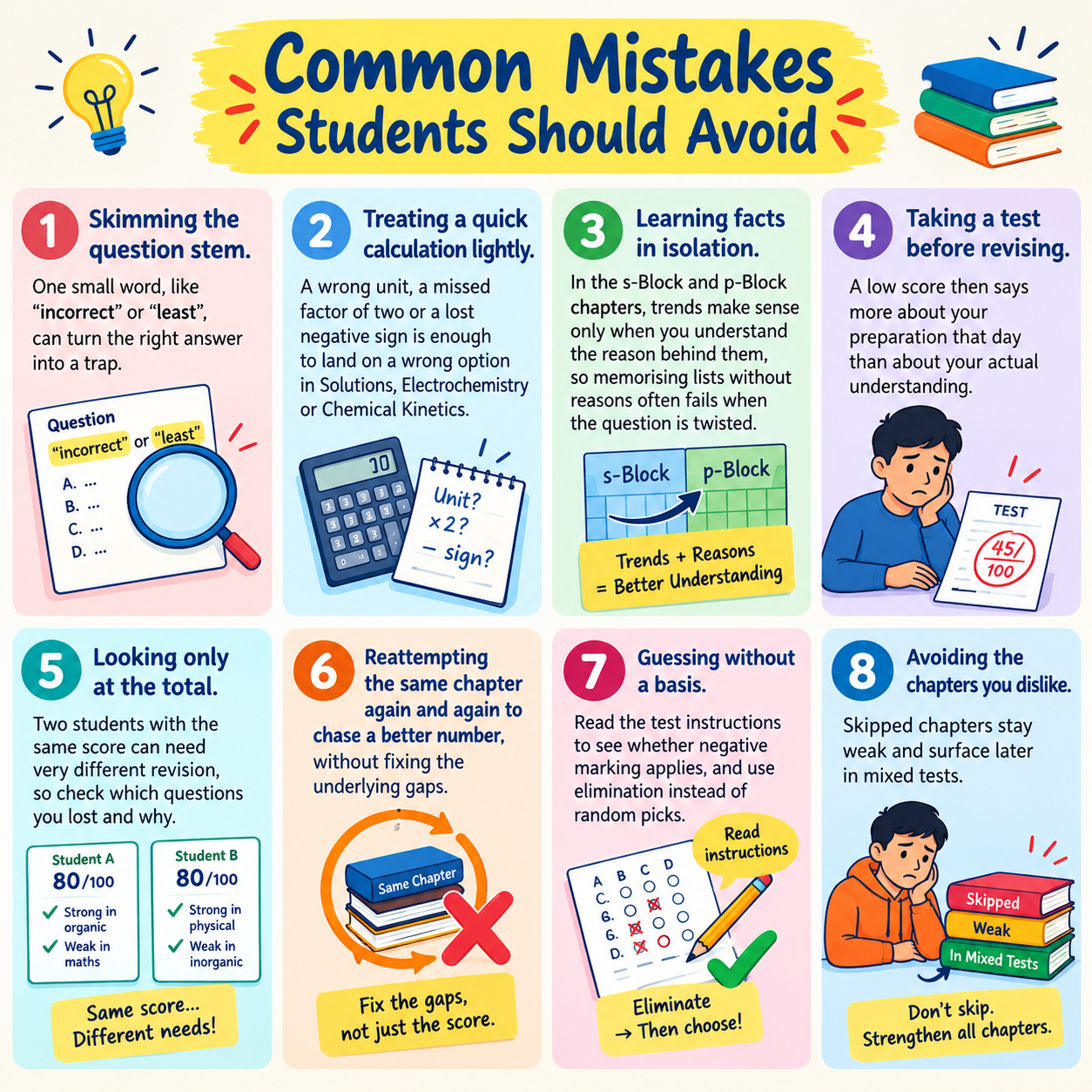
- Skimming the question stem. One small word, like “incorrect” or “least”, can turn the right answer into a trap.
- Treating a quick calculation lightly. A wrong unit, a missed factor of two or a lost negative sign is enough to land on a wrong option in Solutions, Electrochemistry or Chemical Kinetics.
- Learning facts in isolation. In the s-Block and p-Block chapters, trends make sense only when you understand the reason behind them, so memorising lists without reasons often fails when the question is twisted.
- Taking a test before revising. A low score then says more about your preparation that day than about your actual understanding.
- Looking only at the total. Two students with the same score can need very different revision, so check which questions you lost and why.
- Reattempting the same chapter again and again to chase a better number, without fixing the underlying gaps.
- Guessing without a basis. Read the test instructions to see whether negative marking applies, and use elimination instead of random picks.
- Avoiding the chapters you dislike. Skipped chapters stay weak and surface later in mixed tests.
Why Use Aspirations Institute MCQ Tests?
Aspirations Institute was set up in 2004 and has spent more than 22 years working with school students and exam aspirants. The MCQ Tests portal carries that experience online, giving students a way to practise and check their progress without having to be in a classroom.
For JEE Main Chemistry, the portal arranges practice by chapter, so you can follow your own study order. You attempt a test, see the result straight away, read explanations where they are provided and decide what to revise next. That loop of practice, analysis and revision is the point of the platform.
Because everything runs online, you can practise from wherever you are comfortable and come back to any chapter when you need it. Please remember that this is an independent practice portal and not an official JEE Main or NTA website, so use it alongside your textbooks and class notes.
Final Call To Action
Choose one chapter you finished this week, take a timed test on it, and study the result carefully. That single cycle will show you more about your Chemistry preparation than another hour of rereading.
Frequently Asked Questions
1. Are free JEE Main Chemistry MCQ tests available on this page?
Yes, a selection of tests can be attempted at no cost. One example is the first test of Some Basic Concepts of Chemistry. Free tests carry a label in the test list. The rest are premium, and the free selection may change, so check the page for the current list.
2. Do the tests include answer explanations?
Selected tests include explanations. These show how the correct option is reached, which helps most when you got a question wrong. Reading them also helps with questions you answered correctly by guesswork, because the method matters as much as the final choice in Chemistry.
3. Are the tests organised chapter-wise?
Yes. Each test sits under a chapter such as Hydrocarbons, Solutions, Electrochemistry or Chemical Kinetics. Many chapters have several tests, so you can take one soon after studying and another during revision. The page also lists topic-wise and mock tests where available.
4. Is sign-in compulsory before I start a test?
Some free tests may be attempted without signing in. Premium tests generally need sign-in and an active plan. Requirements can change over time, so the safest way is to open the test you want and follow the instructions on the page.
5. Will these tests work on a phone or tablet?
Yes. The tests run on the portal and can be opened on a phone, tablet or computer. Short chapter tests are easy on a phone, though some students prefer a bigger screen for calculation-heavy chapters where they may want to work on paper alongside.
6. Do wrong answers carry negative marks?
Negative marking may apply to some tests, following the JEE Main pattern, but it can differ from test to test. Read the instructions shown before you begin so you know how wrong answers are treated, and plan your guessing accordingly.
7. How do I turn my test results into better preparation?
Treat the score as a starting point. List the questions you missed, note whether the cause was a knowledge gap, a calculation slip or a misread question, and revise only those areas. Then take another test on the chapter to check whether the same mistakes still appear.
8. Can regular practice help me work faster in the exam?
Yes. Every test has a time limit and a fixed number of questions, so repeated attempts show you how long you take on different question types. Over time you can learn which questions to attempt first and which to leave for later.
9. What if my premium plan runs out?
When a plan ends, you lose access to the premium tests it covered, while tests marked free on the page may remain open. You can renew or pick another plan to continue. Your account page and the plan details on the portal give the exact terms.
10. Do the tests cover Physical, Organic and Inorganic Chemistry?
The chapters on this page span all three. Examples include Solutions and Electrochemistry for Physical Chemistry, Hydrocarbons for Organic Chemistry, and the s-Block and p-Block elements for Inorganic Chemistry. Since more chapters exist beyond these examples, check the page for the full list.
Related Tests You Might Like
- JEE Main Physics MCQ Tests
- JEE Main Maths MCQ Tests
- Class 12 Chemistry MCQ Tests
- Aspirations Institute Tuition Classes